
Fifty Years of Yes
 What Keeps Some Alumni Giving, Year After Year
The alumni philanthropy you most often read about is the kind that comes in eye-popping sizes. A landmark endowed fund. The naming gift for a new building. Seed funding for a transformative program. These are great gifts to receive and easy for institutions to tout.
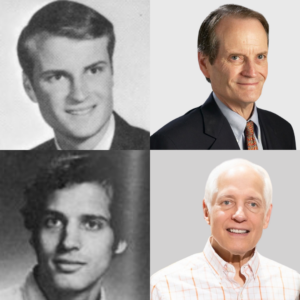
Equally deserving, though, is the kind of philanthropy that Scott Atlas ’75 and Dan Hedges ’74 have been practicing for a half-century. Something arguably harder and more impressive: showing up every single year, for 50 years running, in gifts large and small, without missing a beat. When you ask them why they do it, long after any pangs of obligation might be expected to give way to the practical difficulties of keeping up, their answers reflect a similar small set of core principles.
The first is that some debts can’t be repaid in one fell swoop. Atlas reflects of the struggles faced by his father, Morris, a child of immigrants growing up poor in South Texas. Thanks to education—two degrees from UT Austin, including his law degree in 1950—Morris built a law career out of nothing in McAllen. “He believed to his core that education was the key to future success,” Atlas says. By the time the son graduated in 1975, he believed it too: “The Law School put me on the road to upward mobility and success in life… and I can’t stop being grateful for that.”
Hedges adds that the school kept contributing to his success, even after graduation. “My very first case when I joined the firm that would one day become Porter Hedges, I got from one of my classmates,” he says. “It ended up being one of the biggest cases that I ever worked on.”
“The Law School gives to you throughout your life,” Hedges adds. “You can do the same.”
The second idea is one both men say they learned while still students: tuition and state dollars were never the whole story. Hedges remembers learning through some of his favorite teachers—Texas Law legends such as Page Keeton and Charles Alan Wright—that the Law School Foundation, then a primary channel for alumni gifts, was essential to supporting student scholarships, faculty research, and the extracurricular programs that made the degree experience exceptional.
“The school is great,” says Atlas, “but it can’t stay great through tuition dollars and state support alone. I learned even as a student that what alumni give back is essential to keeping us the greatest deal in legal education.”
Both men also say giving back is an inherited habit from their families who saw generosity as part of being a good citizen. “I was trained to be that way,” says Hedges. “Simple as that.” Atlas tells the same story, though he is quick to point out that he doesn’t regard such generosity as an obligation. “It’s gratitude,” he says.
Finally, both believe that consistency itself is the point. As Hedges puts it, those “year in, year out” gifts help a school budget with confidence: “They know it’s going to be there every year.” Though Atlas acknowledges that, at least in part, his record of giving is something that emerged from habit. “I can’t say I set out to make a donation every year for the rest of my life. It just worked out that way.”
“But I sure am glad that it did.”
Ready to start a streak of your own? However large or small, a gift made every year adds up. Contact Rylee Holder at rylee.holder@law.utexas.edu.