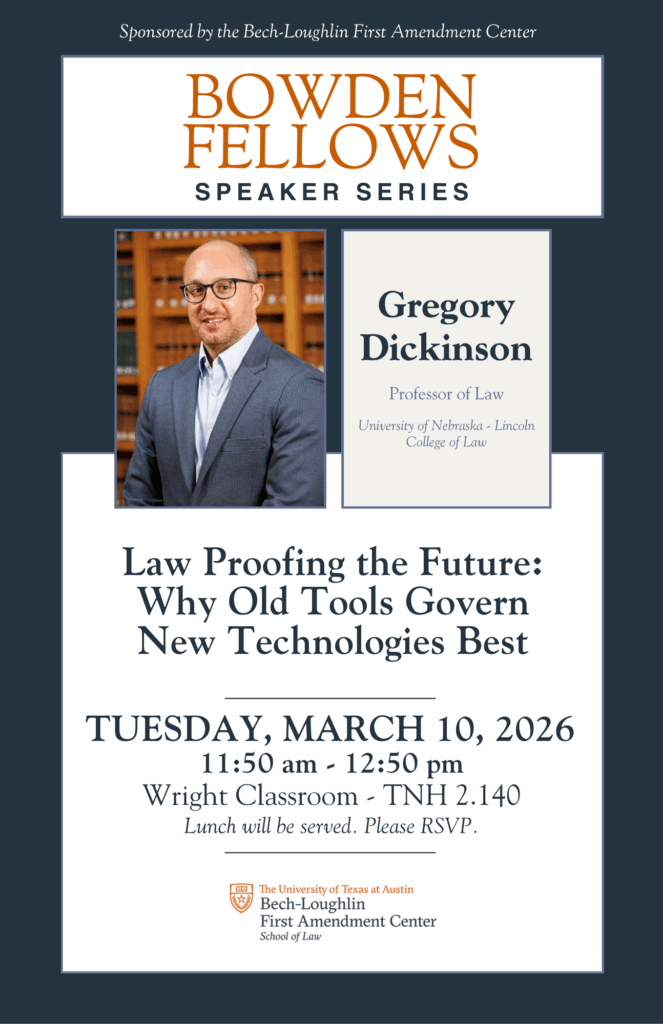
Law Proofing the Future: Why Old Tools Govern New Technologies Best
Calls to “future proof” the legal system against emerging technologies—AI, algorithmic decision-making, deepfakes, and more—now pervade public discourse. Professor Gregory Dickinson challenges the premise that rapid technological change requires similarly rapid lawmaking. Drawing on history, sociology, and public-choice theory, he argues that the most powerful tools for governing technological innovation are the general-purpose principles already embedded in our legal system. From Gutenberg’s press to modern AI systems, premature, technology-specific regulation often entrenches incumbents, suppresses experimentation, and destabilizes legal principles that have proven durable across technological eras. A legal system committed to generality, stability, and adaptability—rather than bespoke rules for each new invention—better protects both innovation and the rule of law.
Professor Gregory Dickinson is an Assistant Professor of Law at the University of Nebraska, where he teach Contracts, Unfair Competition, and Remedies, as well as a fellow with the Stanford Law School Program in Law, Science and Technology. He holds a JD from Harvard Law School (2010, cum laude). Before his current appointment, he practiced at Ropes & Gray LLP in Boston and at two Rochester firms, with a year in between as a law clerk for Judge Richard Wesley of the U.S. Court of Appeals for the Second Circuit. While in full-time practice, he also served as a nonresident fellow at the Northwestern Pritzker School of Law.
Professor Dickinson’s research focuses on the interaction between private law and technology. One major area of interest is how the common law responds to technological innovation and can be harnessed to complement the more particular statutory and regulatory schemes layered atop it. A second branch of his work explores how the tools of machine learning and artificial intelligence can be brought to bear on traditional legal questions. Through computational analysis of large bodies of case law, his research seeks to provide a more systematic view of our legal system and doctrines and to guide legal reforms and policy decisions. His work has appeared in leading journals including the Georgia Law Review, George Washington Law Review, Stanford Law & Policy Review, and the Administrative Law Review.