“Faithfully Interposing the Constitutional Shield”: Quaker Legal Resistance, the Right of Petition, and the Federalization of Slavery
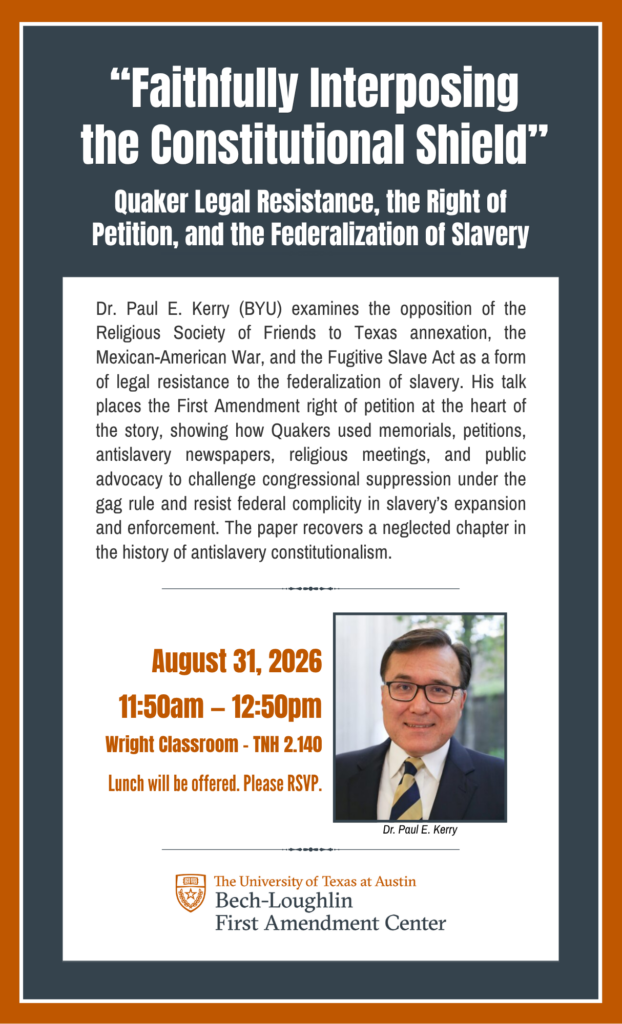
Dr. Paul E. Kerry (BYU) examines the opposition of the Religious Society of Friends to Texas annexation, the Mexican-American War, and the Fugitive Slave Act as a form of legal resistance to the federalization of slavery. His talk places the First Amendment right of petition at the heart of the story, showing how Quakers used memorials, petitions, antislavery newspapers, religious meetings, and public advocacy to challenge congressional suppression under the gag rule and resist federal complicity in slavery’s expansion and enforcement. The paper recovers a neglected chapter in the history of antislavery constitutionalism.
Dr. Paul E. Kerry is Associate Director of the International Center for Law and Religion Studies at BYU Law School and Associate Professor of History at Brigham Young University. His scholarship focuses on transatlantic intellectual history and the historical development of religious freedom and religion in public life, particularly at the intersections of religion and law, with attention to the protection of religious liberty and pluralism in constitutional democracies. His professional engagement includes humanitarian and policy initiatives addressing religious freedom and genocide prevention.
He has worked with the AMAR Foundation and has served in advisory and research capacities with United Kingdom All-Party Parliamentary Groups addressing Freedom of Religion or Belief, the Prevention of Sexual Violence in Conflict, and Genocide Prevention. He serves on the United States Holocaust Memorial Museum’s Committee on Religion and the Holocaust.
Dr. Kerry is a Fellow of the Royal Historical Society and an Honorary Fellow of the Woolf Institute. He has held visiting appointments at Princeton University, the University of Heidelberg, the London School of Economics, the University of Cambridge, and the University of Oxford, where he earned his DPhil.