
On the rule of law.
As told to Thomas Rielly
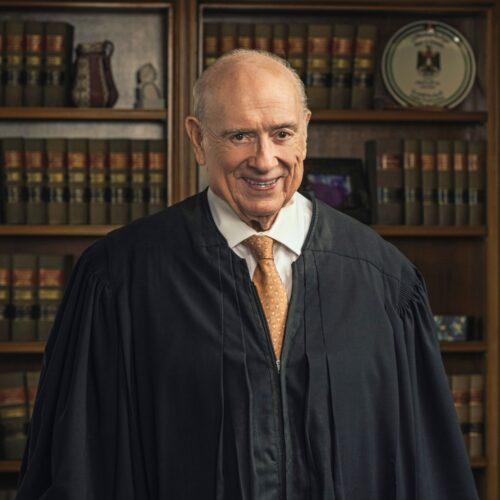
Portrait by Stephen Voss
He has witnessed history — and made it — as a federal judge in Washington, D.C. Appointed by President Reagan in 1987 and named Presiding Judge of the FISA Court by then Chief Justice Rehnquist in 1995, Judge Royce Lamberth ’67, continues to make headlines as a senior judge. 3L Thomas Rielly, past president of Texas Law’s Veterans Association, spoke to the judge about his most challenging cases.
You’ve presided over January 6 cases that continue to divide the nation. How do you approach it?
Our approach is that partisan politics has nothing to do with what happened on January 6, and we proceed in the same nonpartisan way we have always done. Whatever one’s political views are of the events of that day, there was a riot that occurred. People overran the police. Police lines were set up and overrun by people assaulting policemen, people who went through tear gas. The cases we have tried all had videotapes. Those videotapes are played and in each jury trial the defendant has been convicted. The idea that these people didn’t know that it was illegal to go in the building, every jury has found preposterous. Some Congressmen say these are political prisoners. They’re not. They’re convicted felons. Saying that these are political prisoners, that’s preposterous – and somebody has to come out and say it. I do not shrink from controversy, obviously. (Laughs.)
Have things gotten more difficult trying to maintain impartiality on the court?
The judiciary above all needs to show that one branch of government works! We have to show that we’re nonpartisan and will rule on what we think the law is. The other branches can go back and forth however they feel like they need to, but our branch needs to work. A lot of people throw bricks at the Supreme Court these days but the Supreme Court works. Our branch is trying to uphold the rule of law, working together to come out with decisions together. It’s unfortunate that sometimes our decisions sound political or are made to look political. We’re still just trying to uphold the rule of law.
You were Presiding Judge of the FISA Court on 9/11. What was that like?
No question, that’s most important thing I have ever done. From our intelligence, we knew 9/11 was coming. But we just didn’t put the pieces together. That was a tough time for me, and everyone working on security issues, and for the nation. And I’ll tell you, we are living right now in another very dangerous time. When might the next shoe drop? The FISA Court was, and still is, vital to making sure that intelligence agencies are carrying out their duties in a diligent manner to ensure that private citizens’ rights are not being infringed.
As a veteran myself, I have to ask what being a JAG in Vietnam was like?
I graduated from law school in 1967, with the Vietnam War in full swing. I knew I would end up going to Vietnam, but I expected a one-year deferment so that I could accept a clerkship with Judge Onion on the Criminal Court of Appeals in my hometown of San Antonio. In fact, they turned my deferment request down and put my draft notice in the same envelope!
The 1968 Military Justice Act took effect the first year I was in the army, requiring JAGs to do more than they had ever done. I tried 300 cases my first year as a lawyer, including six murder trials. Trying cases seven days a week, five cases a day. It was an unbelievable experience after which I was offered any assignment in the world I wanted. I knew there was just one spot for a JAG Captain at the Pentagon and I wanted it. Happily, the Judge Advocate General said, “Okay, it’s yours.” And that was the best job I ever had. I learned more than I ever did anywhere, flying all over the country arguing cases where the army was sued. It was a terrific variety of cases, I had a great boss at the Pentagon, and you got a lot of responsibility a very early time.
Why do you think President Reagan appointed you to the D.C. Circuit in 1987?
Honestly, when Reagan came into office, I thought I was going to get fired from the U.S. attorney’s office—I’d been too visible during the Carter administration! But two months into Reagan’s presidency, he got into a confrontation with the air traffic controllers, who had gone on strike. I ended up being the one who brought the temporary restraining order against the strike. That was at three o’clock in the morning. At five o’clock, I got the union held in contempt. At seven, we dissolved the union. At nine o’clock, Reagan fired all the air traffic controllers. It turned out to be a huge political victory for Reagan and he never forgot.
So, what was the feeling when you found out about the nomination?
I was dumbfounded. I had no idea that I would ever become a judge. That night, I raised it with my wife, and she said, “But that’s for life!” (Laughs.) We always thought we’d move back to Texas. The idea that we might be here in Washington for life was not in our heads. And now it’s been 37 years, come November 16th.
Is Texas Law a springboard for being successful anywhere? D.C., for example?
Absolutely. I have the very best graduates in the country clerking for me, and that includes someone from Texas Law every year!
Let’s move on to something really important: Texas football.
Oh, yes! (Laughs.) I’m a big Texas football fan. I don’t miss a game on TV, and I’m hoping for a good year this year. And we’re playing A&M! That’s our greatest rival and all these years we didn’t play them was awful. I’m glad it’s back.
This is an extended version of the interview with Judge Lamberth that appeared in the Fall 2024 issue of Texas Law Magazine. It has been edited for length and clarity.