
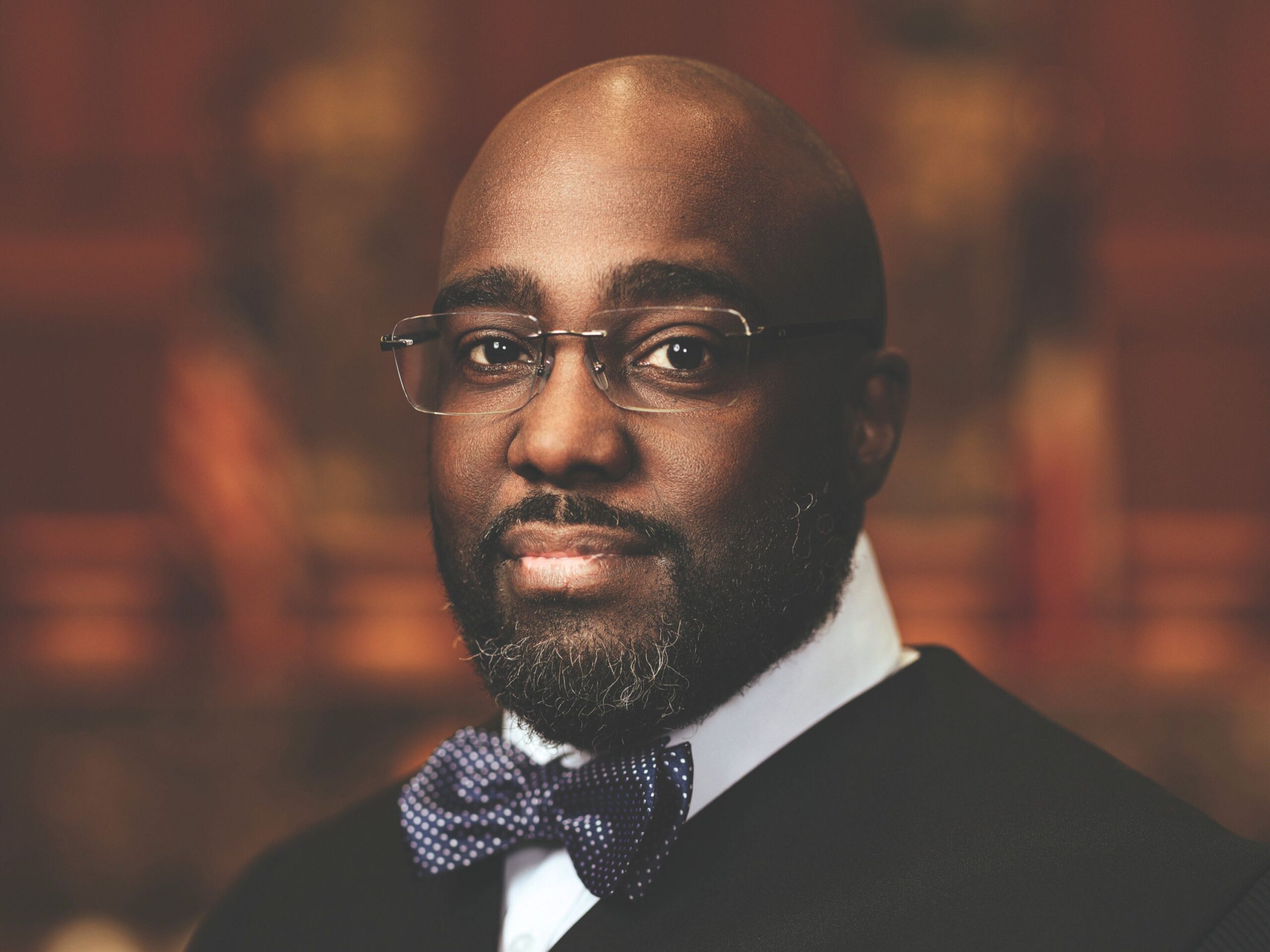
Q&A with Texas Court of Criminal Appeals Judge Jesse F. McClure III ’99.
As told to Deborah Lynn Blumberg
Portrait by Josh Hushkin
When Judge Jesse F. McClure III ’99 walked the halls of Texas Law, his classmates didn’t picture him in appellate robes. In an informal vote, they tagged him as a future politician or FBI agent, anything but a judge parsing records and precedents. They were wrong. Today, McClure sits on the Texas Court of Criminal Appeals, the state’s highest court for criminal matters, where he helps decide the fate of thousands of cases each year. We asked him about a path that was anything but linear.
Your undergraduate degree was in philosophy.
It taught me that everything’s a trade-off. There’s no system of thinking that’s foolproof. For example, if you focus on procedure, you can get lost in the weeds and forget that real human beings are involved. If you focus only on results, you may burn down the whole forest just to catch the grasshopper. Procedure has its place. The result has its place. But if you go too far in one direction, you wind up doing a kind of violence to the system.
By the end of your 1L summer, your interest in prosecution took shape?
My dream was to be an FBI agent. But I saw the work federal prosecutors were doing. They really seemed to enjoy their jobs. My dream shifted from being the one investigating the case to being the one trying to prosecute it. Same mission, just a different goal. I always felt I was trustworthy enough because I’m a fair person. It’s obviously important as a judge to be fair. But I think it’s more important to be fair as a prosecutor because you can really ruin somebody’s day, or even their entire life.
What makes a prosecutor’s office unique?
Very few professional environments are like a public defender’s office or a district attorney’s office. It’s like being on a sports team: There’s a camaraderie, and everyone pitches in to help and is rooting for each other. There’s a shared unity of purpose. When I left the DA’s office to go do civil work for the federal government, within a few months I really missed the environment and the way things are done. I then had an opportunity to come to Houston to work as a prosecutor handling white collar crime, and I took it.
The older I’ve gotten, and the more experienced I’ve become, the more I reflect on how I think we take freedom for granted.
How did your decades as a prosecutor shape how you approach justice today?
I was prosecuting a case, a jury trial. This was back in the days when you used poster board exhibits. I had a board that the defendant couldn’t see. The judge kept saying, “Mr. McClure, you need to move your exhibit so everyone can see it.” She said it four or five times. On break, she called me to the bench and said: “This isn’t your trial. See that person sitting over there you want to put in prison? It’s their trial. They need to be able to see what you’re doing.” It’s probably been more than 20 years at this point, and that has always stuck with me. Because, at the end of the day, everyone in that courtroom is going home, except perhaps the defendant.
What do you wish more people understood about serving on the highest criminal court in Texas?
Intellectually, it’s very challenging. It makes you look inside yourself and ask, “can I be factually convinced somebody is guilty of a crime, and yet also find their lawyer was ineffective and they should have a new trial?” When people say life and liberty are at stake in criminal cases, it’s not a euphemism or throwaway statement. The older I’ve gotten, and the more experienced I’ve become, the more I reflect on how I think we take freedom for granted.