
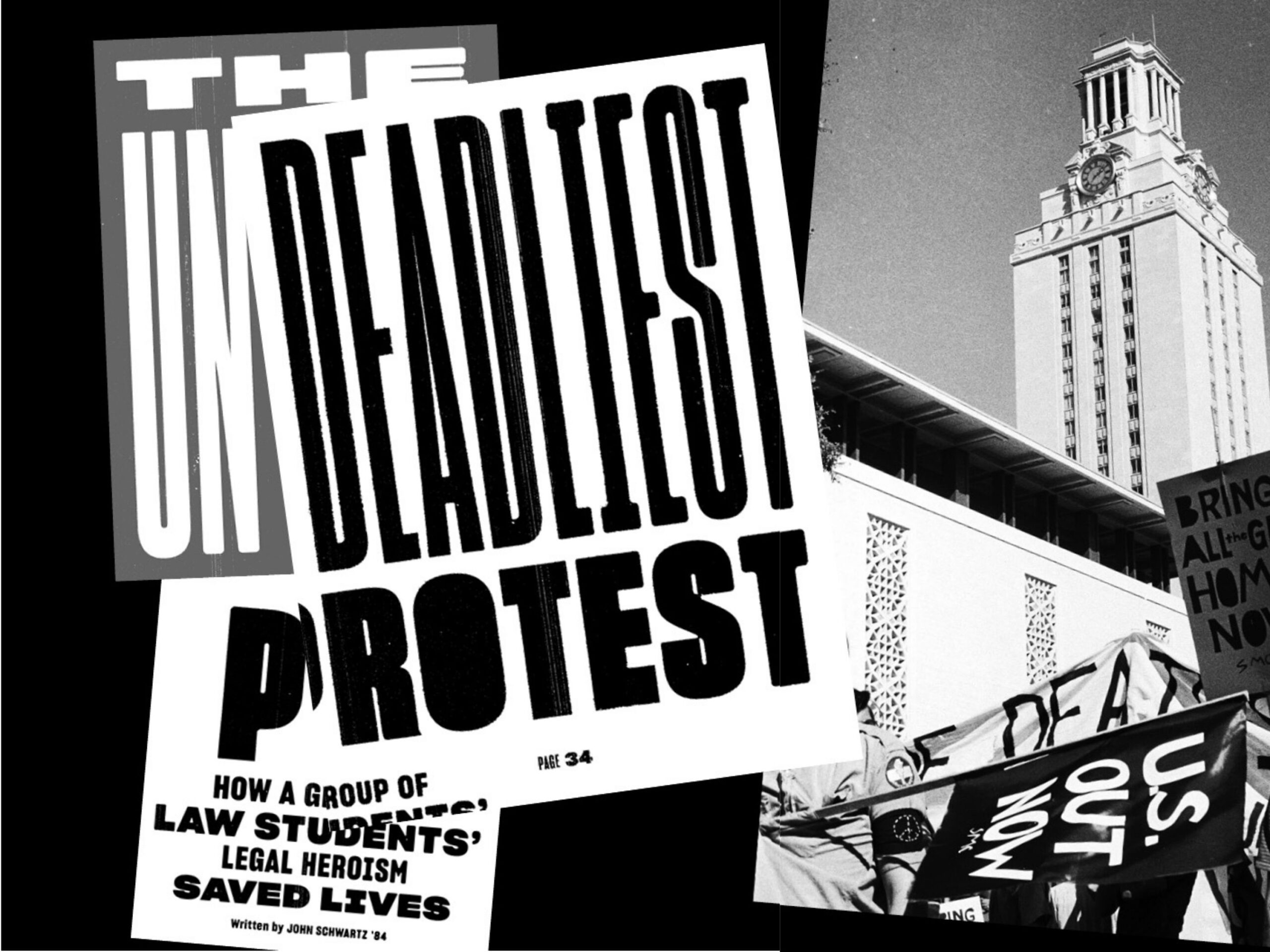
How a group of law students’ legal heroism saved lives.
Written by John Schwartz ’84
Opening Spread by Scott Newton
Photographs by David Hopkinson, Ph.D., Austin American-Statesman, and The Daily Texan

Richard Mithoff ’71 Had a Problem.
He and a group of fellow law students had just pulled an all-nighter hammering out a request for a court order that could avert a bloody riot. Now he wanted to attend the hearing. Mithoff, born in Lufkin but raised in El Paso, was just a scrappy law student and not the now-famous trial lawyer. He didn’t own a jacket. “I had to borrow a coat to get in,” he recalls. It was a little big, but it fit well enough. And so, he got to experience a court win that still thrills him 56 years later.
At the tumultuous beginning of May 1970, UT Austin students were planning a march to protest the invasion of Cambodia and the killings at Kent State University just days before. But the Austin city council refused to issue a parade permit, which meant thousands of students would be confined to marching on the sidewalks. The situation was likely to become unmanageable. There had already been tear gas, billy clubs, and bloodshed from a smaller march just days before.
“If you ask when in Austin was ever the capacity for serious violence at its highest, to my mind it was that moment right there,” says Glen Wilkerson ’71.
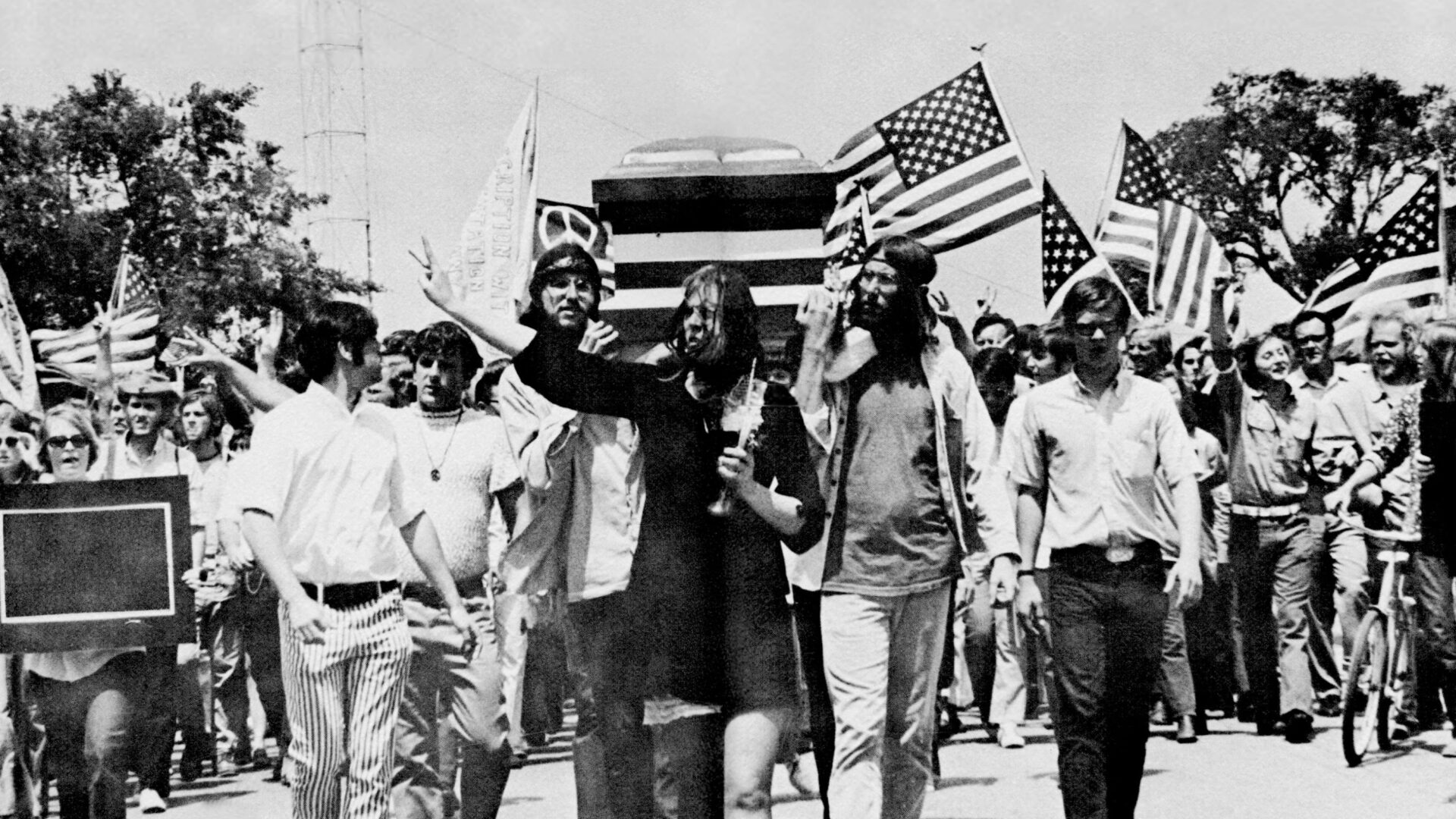
On Friday, May 8, as the march was forming, a federal judge held a remarkable hearing to consider the law students’ arguments defending the marchers’ First Amendment rights. He ordered the city to allow the march. Twenty-thousand people took to the streets, the largest protest in the city’s history at the time. Peacefully.
If you ask when in Austin was ever the capacity for serious violence at its highest, to my mind it was that moment right there.
Glen Wilkerson ’71
It was an act of legal heroism by the law students, particular to the profession and a hallmark of the educational tradition of Texas Law: To be calm in a crisis and not get pulled into the fray, but to use whatever resources you can muster to get things done.
Few know about their achievement today, and at the time it garnered no national publicity — precisely because the law students won. There’s a cynical saying in journalism: “If it bleeds, it leads.” Violence is newsworthy. By comparison, peace doesn’t get much ink. But 56 years later, it’s time to revisit their near miraculous efforts.
This is a story about what went right.
Tinderbox
Protests had roiled the nation’s campuses in those days over Vietnam, civil rights, the environment, and more local issues; UT had its share, too. The previous October, thousands of students had taken part in the national moratorium against the war; later that month, in the Battle of Waller Creek, students climbed into majestic live oaks, pecan, and maples to prevent the school from tearing them down to make way for a stadium expansion; police pulled the students out and the trees came down. In November of that year, a confrontation with police over whether nonstudents were allowed in the Texas Union snack bar called the Chuck Wagon became known as the Chuck Wagon Riot.
In 1970, as the spring semester ended, tensions flared with President Richard Nixon’s expansion of the war into Cambodia, announced on April 30. Campuses erupted in protest once again, with tragic results: On Monday, May 4, National Guardsmen at Kent State University opened fire on demonstrators, killing four students.
The next day, a spontaneous 4,000-person march from the campus to the Texas capitol building ended in chaos. Some of the marchers threw bottles and rocks at police, injuring a half dozen of them; the police bloodied and arrested five students, according to a contemporaneous account by former UT Austin Psychology professors Ira Iscoe and Philip Mann. While there were no serious injuries, tensions rose even higher — and students planned another, bigger march for Friday, May 8.
There was no way the police, even doing the best they could, could contain that number of students.”
Richard Mithoff ’71
The city refused to allow it, citing a provision of the city code requiring more than two weeks’ notice for a parade permit. (City council minutes said 15 days; the student brief would say it was 20 days.) Without a parade permit, the students would have to keep to the sidewalks. With some 20,000 protesters expected, Mithoff and others realized the city’s sidewalk rule would likely become a mob scene.
“There was no way the police, even doing the best they could,” he says, “could contain that number of students. And there was certainly no way a march on the sidewalks could work.”
Dan Hyde ’71 agreed, “All of this energy and anger, you’re going to cram into these little sidewalks? You could just see a disaster in the making.” Governor Preston Smith increased the pressure saying if violence occurred, “I will not hesitate to use whatever force is necessary to put it down.”
Practicing Law
As Mithoff and fellow law students discussed the march and their fears, they decided to use the tools they were learning in law school to persuade the city to allow the march. Hyde remembers it as a shoestring effort. “We had no law licenses; we had no clients; nobody was admitted to practice” in federal court.
They knew they couldn’t apply for an injunction until they had exhausted state remedies. So, on May 7, the day before the march, Mithoff and Jack Strickland ’71 went to the city council to formally ask the city to waive its notice rule. Predictably, the council turned the students down and they took their case to federal court.
After that city hall meeting, Mithoff made one more stop: He walked into the Austin Police Department and asked to see the chief of police. To his astonishment, the chief, Bob Miles, agreed to sit down with him. Mithoff asked Miles, “If we can get the relief we’re asking for, would that help relieve some of the pressure on y’all? He said, ‘absolutely.’”
Mithoff raced back to campus with the news, where things were gearing up at the law review. They had the cream of the school’s legal talent, and had gotten pledges of assistance from Texas Law professor George Schatzki, an expert in labor law, and civil rights attorney David Richards ’57. Schatzki’s role would be essential: he could appear in federal court.
The students — accounts number them between 14 and 20, with a core from the law review — did the research, made calls, and figured out their arguments. Two members of the Texas Law Review, Tommy Jacks ’71 and Hugh Lowe ’71, took the lead composing two documents: a request for the injunction and the memorandum brief.
Sam Simon ’70, managing editor of the Law Review, had valuable assets: An I.B.M. Selectric typewriter and fast fingers. “I typed other kids’ papers for money,” he says.
“His typing skills were incredible,” recalls Wilkerson.
The complaint was a perfect match for Simon’s skills. “I could edit in the process, and I knew the law,” and he quickly retyped pages after proofreading. The documents argued that the waiting period was unconstitutionally restrictive. They drew some of their argument from a law review article by legendary Texas Law faculty member Charles Alan Wright, an expert on federal courts. His essay “The Constitution on the Campus” had appeared the year before in the Vanderbilt Law Review, and included relevant cases, as well as a passage that could have been written expressly for their purposes. Requirements of notice for demonstrations “can validly be required,” Wright wrote, but those restrictions “can be abused, and the notice rule ought to have enough flexibility to accommodate the truly spontaneous demonstration in response to such tragic events” as the assassination of Dr. Martin Luther King Jr. in 1968.
The “complaint and motion for temporary relief” filed on behalf of the “Ad Hoc Strike Committee of the University of Texas,” listed six student plaintiffs: Lowe, Jacks, Robert Walls ’71, Joe Tom Easley ’71, Simon, and Claudette Lowe, BA ’63. (Hyde notes that he didn’t sign the document because he was afraid if he did, he would “get kicked out of the ROTC and get drafted.”) The plaintiffs argued that the city’s ordinance violated an essential element of First Amendment protection: that restrictions on speech must not crush the spontaneity of expression.
The memorandum called the notice period “not only unreasonable, but impossible.” The students couldn’t file for the permit 20 days before the event because the invasion of Cambodia and the Kent State massacre had occurred only a few days before, the filing noted. And besides, the city had granted quick permits in the past for “such parades as a football spirit rally,” making the city’s refusal in their case arbitrary, capricious, and discriminatory.
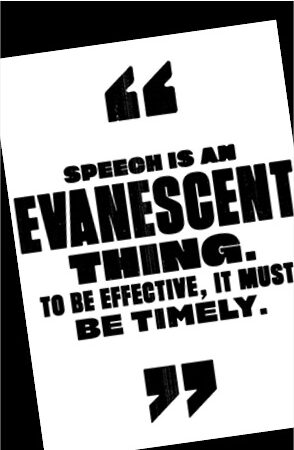
“Speech is an evanescent thing. To be effective it must be timely,” the plaintiffs argued. “In 20 days, the students of this school will all have ended the semester, and there will be no way for them to gather the group they now have. The events will have faded into headlines of a month ago.”
The Wright Effect
Once the document was complete, the students looked to Professor Wright. “We knew it would be a real coup if we could get him to read and sign the brief,” Jacks says. They deputized Walls to carry the document to Wright’s office at 7 a.m., when the professor typically appeared on campus.
Wright was intimidating, and “it certainly would have scared the hell out of me to approach him,” Jacks recalls. “I’m sure Bob Walls was a-tremble!” Even with their reliance on Wright’s law review article, his support would be no sure thing. But “I’ll be damned if [Walls] didn’t come back with Charlie’s signature on it!” Hyde remembers with a chuckle.
Wright had gone through the document page by page, making small changes in pen, and then signed it.
“Against what we thought were all the odds, everything fell into place,” says Jacks.
It was time to go to see the judge: Jack Roberts ’33, a WWII veteran and appointee of President Lyndon Johnson. Roberts, four years into the position, had never issued an injunction involving adversarial parties.
He read the filing all the way to the signatures. Schatzki delivered their argument and Glenn Cortez argued for the city. The judge invited the attorneys for a discussion in his chambers. When they emerged, the judge granted the request for a temporary restraining order enjoining the city from enforcing its “so-called parade ordinance,” Roberts said, according to the transcript. “The guaranteed right of free speech will be irreparably harmed if the requested parade permit is denied.”
Judge Roberts added his own worries about the march: “I can’t anticipate or foresee that there will be violence when this parade takes place. God knows, I hope and pray to the Good Lord above that there won’t be.”
The judge’s decision was still a bit unclear to the city attorney, who appeared to think it might still prohibit a march. Schatzki asked the judge to restate it. “The effect of the order is this,” he said: “That if you have a parade, they walk in the streets.”
Just Like That
They had won. But the march had already begun, with students packing the sidewalks near the campus. Mithoff had the court clerk print the judge’s order, ran out of the courthouse and up to the head of the march, where “I went to the first policeman I could see.” He handed over the order. “The guy, to his credit, said, ‘fine’”— and the police immediately began waving the crowd into the street.
Edward Prado ’72, who later would become a federal judge, ran toward campus to find the student leaders of the march. “I crossed red traffic lights and ran in front of cars trying to get to the marchers,” he recalled. “When I got there it took me a while to catch my breath.” The startled students “had no idea who I was, and if the information I was giving them was correct,” he recalled, but “a policeman standing by informed the leaders that he had just heard the same thing on the radio.”
And with that, the tension, built over days drained away, Jacks recalls. “It was momentous, and it was orderly, and it was just a fabulous event,” he said.
It was momentous, and it was orderly, and it was just a fabulous event.
Tommy Jacks ’71
The Daily Texan account of the march in the next day’s special edition captured the jubilance. “Red, white, and blue were the dominant colors of the day” wrote the reporter, Cliff Avery BJ ’73. “One laughing child, barely a year old, bounced on the back of his father, and carried a flag sewn onto his shirt… Police were in evidence only to control traffic at busy Austin intersections and were generally cooperative. Three demonstrators rode on the back of police motorcycles which headed the parade and often waved the two-finger peace symbol along with the protesters. At the end of the march, demonstrators chanted ‘More pay for Austin police’ as a gesture of thanks.”
The next week, on May 15 in Jackson, Mississippi, state highway patrolmen and city police officers fired into a group of students at Jackson State College (now Jackson State University), killing two students and injuring twelve — a sobering reminder of what might have happened in Austin.
Later that month, Mithoff and the others received a congratulatory letter for their “outstanding service” from Page Keeton, the dean of the law school. Keeton wrote that he had to be out of town on the day of the march, “but I learned on my return of the tremendously successful work that you did in order to induce my old handball partner, Jack Roberts, to declare the action of the City Council unconstitutional as regards to the street marching. All in all, this probably averted violence and trouble and permitted the use of the streets for expressing the magnitude of the opposition to the expansion of the war in Cambodia.”
Easley wrote a note to Professor Wright, as well, thanking him for signing on. “We are in unanimous agreement that your signature on our pleading was of incalculable assistance to our cause.”
For some, the experience helped shape their legal careers. Easley and Simon would work for consumer advocate Ralph Nader, becoming part of the first group of Nader’s Raiders. Easley would go on to be a major figure in the fight for gay rights. Simon, walking home and seeing the students pouring into the streets, says he experienced one of those “moments in our lives” when “your work is no longer theoretical. All of a sudden, it’s real.” In a book he edited about the early Nader years, Choosing the Public Interest, he wrote that “I knew then that I had a different future ahead of me than I had anticipated.” He wanted, he wrote, “to be an agent for change.”
Mithoff, who got a clerkship with Judge William Wayne Justice ’42, a civil rights champion, says the experience deepened his passion for the law and for “the thrill of winning. And winning for a good cause.”
When the dust settled, it was Texas Law professor Bernard Ward — a giant of civil procedure scholarship — who captured the essence of what the group of law students had accomplished. “Most of you will go on to practice law, and have many, many cases,” Ward told them. “But you’ll never have a moment like this again.”
Mithoff, looking back over a long and successful career, agrees. “The law is generally deliberate and can take years to develop even before the first day of trial,” he notes. But the scramble to allow the Austin march was quick and decisive. “This kind of rush doesn’t happen very often, but it’s a thrill when it does,” adding, “Bernie Ward was right.”