
How Genetic Genealogy Became Law Enforcement’s Unexpected Breakthrough Tool
By Robin Berghaus
Art by Aldo Jarillo
Portrait by Lauren Segal

At 3 o’clock one morning in April 2018, Barbara Rae-Venter ’85 was working alone at home, too wired to quit. For months, she helped investigators track down one of the most heinous criminals in U.S. history. Now, they were closing in on his identity, anxiously awaiting the final pieces of a puzzle that would unlock a decades-old investigation. The Golden State Killer began his crime spree in the 1970s — murdering at least 13 people, and torturing and raping dozens of victims throughout California. In 1986, after his last-known crime, he vanished, leaving behind bits of his DNA. Even after thousands of people were surveilled, investigators lacked a solid lead, and the case went cold for decades. As law enforcement searched for their moonshot, they discovered Rae-Venter. Using a unique skillset, she would not only guide investigators to identify the Golden State Killer and other criminals, but, in doing so, help launch the most important breakthrough in forensic science in decades.
Amateur Sleuth
She is not a police officer nor a prosecutor. She never trained as a criminal investigator. Rae-Venter is a retired patent attorney whose past life as a scientist and passion for family history prepared her to become a genetic sleuth. Pioneering investigative genetic genealogy (IGG) before it had a name, Rae-Venter helps solve unsolvable crimes.
Rae-Venter happened into IGG in 2015 while researching her family roots and volunteering at DNAAdoption. There, as a search angel, she helped adoptees find their biological relatives. That service brought her to the attention of Peter Headley, then a sheriff’s deputy in San Bernardino County, CA. He wondered if Rae-Venter could help uncover the true identity of Lisa Jensen, a woman who had been abducted as an infant.
Without any clues about her family or birthplace, they used Jensen’s DNA to find her relatives through genealogy websites. It was the first use of IGG in a criminal case. “I couldn’t have done it without Barbara,” says Headley.
That case was just the beginning. After pinpointing where Jensen had lived as a baby, the National Center for Missing & Exploited Children realized her home was near the scene of a 1980s unsolved quadruple homicide, the Bear Brook murders in Allenstown, NH. Headley informed the New Hampshire State Police and teamed up with Rae-Venter again. Using IGG, they identified three of the Bear Brook victims, all of whom were killed by Jensen’s abductor. The serial killer, whose real name is Terry Rasmussen, would murder women then steal their children. Posing as a single dad, he lured in more victims.
Investigators assume Rasmussen, now dead, killed Jensen’s mother — she has never been found.
Golden State Killer
When Paul Holes learned about these cases, he perked up. The Contra Costa County investigator had been hunting the Golden State Killer for more than 20 years. Holes and FBI attorney Steve Kramer thought IGG could bring the killer out of the shadows, but they needed help. Rae-Venter signed on to mentor their team, which included three additional investigators from the FBI and the Sacramento District Attorney’s Office.
Solving decades-old cases is difficult for many reasons. Memories fade. Witnesses move or die. Their biggest hurdle: evidence was running out.
Plenty of the Golden State Killer’s DNA had been collected at dozens of crime scenes. But every time DNA is used to run a test, less physical evidence remains. Since Contra Costa County had used all the DNA it possessed, the team inquired with other counties where the killer had struck. Most authorities declined— either they had run out of DNA or opted to save the little they had left for their own investigations.
After six months of knocking on doors, they finally caught a break.
The Ventura County Medical Examiner’s Office was once home to a fastidious forensic pathologist. Dr. Peter Speth always prepared two rape kits — one for police, and the other he preserved. The practice wasn’t common, but Speth thought a backup was prudent.
Deep inside Speth’s former lab freezer were the duplicate rape kits, including one he collected in 1980. Charlene Smith had been raped before she and her husband were bludgeoned to death with a wooden log. For 37 years the kit sat in the freezer, never opened, perfectly preserving the Golden State Killer’s DNA.

Guardian Angel
Moments of serendipity like this occur more frequently than Rae-Venter is willing to chalk up to chance. When a door is shut, something fortuitous nudges it open. Crucial evidence is rescued. A stranger offers key details about a family tree she’s researching. Someone submits their DNA which cracks open a case. Rae-Venter admits it must be strange to hear her – a trained scientist – speak about guardian angels. But, she believes she’s not alone in her views. “As Albert Einstein purportedly once said, ‘Coincidence is God’s way of remaining anonymous.’”
“It was like we had a guardian angel out there helping us,” says Rae-Venter.
Investigators had the killer’s DNA, but needed to translate it into a usable digital SNP file, short for single nucleotide polymorphism. SNP files are vast and contain specific genetic information required for deep ancestry research. Unfortunately, government labs weren’t equipped to produce one. They create STR files for law enforcement databases.
STR files comprise DNA sequences called short tandem repeats. Because these sequences repeat a variable number of times for different individuals, STRs are essentially unique identifiers that work well for one-to-one identity matching. But STRs are too simple and don’t contain the type of genetic information compatible for genealogical research.
So, Kramer contacted companies that create SNP files from consumers’ saliva or cheek swabs, hoping one could produce a SNP from the rape kit. Most declined the unusual request, but FamilyTreeDNA agreed. It’s founder, Bennett Greenspan, told The Wall Street Journal in 2019, “In this case, it was easy. We were talking about horrendous crimes. So I made the decision” to help the investigation.
After Greenspan’s lab created the SNP, it was uploaded to profiles on FamilyTreeDNA and GEDmatch, genealogy websites consumers use to search for biological relatives. Thousands of matches appeared, each from a person who shared some DNA with the killer.
Reverse Genealogy
Facing mountains of data, Rae-Venter taught the investigators a methodology she learned at DNAAdoption, so they could divide the workload and help her build separate branches of the killer’s family trees. Their goal was to identify two people who shared the highest percentage of DNA with the killer. Children inherit about half their DNA from each parent. Siblings share about a quarter. First cousins share about 12.5 percent, and so on.
The team found several third and fourth cousins, but building trees from distant relatives is time-consuming. Hoping for closer matches, Rae-Venter uploaded the SNP to MyHeritage, where she discovered a second cousin — a significant break.
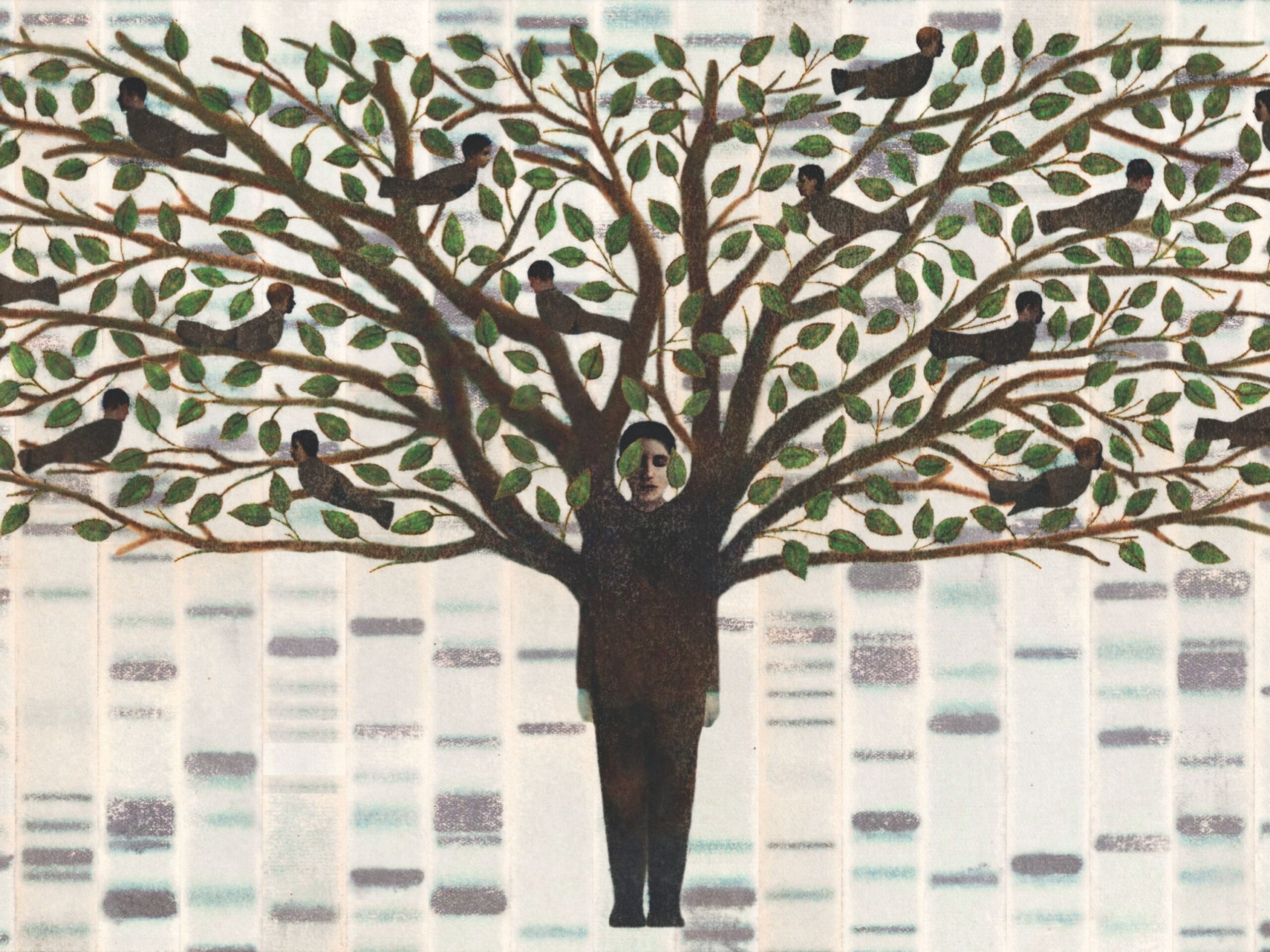
On average, a person might have more than 100 third cousins. For second cousins, the average drops to around 20. Second cousins also share a set of great-grandparents, in this case, the killer’s most recent common ancestor investigators needed.
Working back in time, the team traced the family lines as if drawing a triangle. The cousins were at points on the base, and the set of great-grandparents at the top. From there, Rae-Venter and the team reversed course, building out the killer’s family trees from those great-grandparents toward recent generations: children, grandchildren, nieces, nephews, etc. They added names only after confirming identities with primary sources, including birth and death certificates, marriage licenses, and census records.
Gradually, they whittled thousands of distant relatives down to a suspect list of six men. Each had lived near the crimes, was in the killer’s assumed age range, and was either a close genetic relative or was the killer himself.
While investigators researched the suspects’ backgrounds, Rae-Venter used tools that analyze DNA sequences for physical traits. The analysis predicted the killer likely had blue eyes. When Rae-Venter scanned the spreadsheet investigators created with intel on the suspects, she paused for a moment, taking in a striking fact. Of the six suspects, only one had blue eyes.
Joseph James DeAngelo not only had blue eyes, but investigators learned the former police officer had been fired from the force in 1979. He had also lived and purchased weapons in Northern and Southern California near the Golden State Killer’s crimes.
The team was confident he was their man. But these findings were still just leads — they would need physical evidence tying him to the crimes.
Outside DeAngelo’s Sacramento home, detectives patiently awaited the right moments to collect his DNA. One day, while he was inside a store, they swabbed his car handle. Another day, they collected a tissue he discarded. Detectives sent DeAngelo’s samples to a lab — both matched the crime scene DNA. “It was a gazillion to one that it could be anybody else,” says Rae-Venter.
On April 25, 2018, Sacramento officials announced DeAngelo as the suspected Golden State Killer. The case made international headlines, thrusting IGG into the mainstream.
In 2019, Rae-Venter was named one of TIME’s 100 most influential people. Holes penned the intro, celebrating Rae-Venter for providing law enforcement with “its most revolutionary tool since the advent of forensic DNA testing in the 1980s.”
A Curious Mind
Rae-Venter, originally from New Zealand, came to the U.S. in the late 1960s to study science. She earned a PhD in biology from University of California San Diego, completed a postdoc, and began a tenure-track research faculty position at The University of Texas Medical Branch at Galveston. Her research focused on creating a breast cancer drug. Over time, she began considering medical ethics and a career in law instead.
In 1982, Rae-Venter arrived at Texas Law as a single parent, tackling her studies with a determination and grit that still informs her work. Upon graduating, she and her young son settled in California. With her PhD in biology and her law degree, Rae-Venter became a leading patent attorney— eventually opening her own firm — representing biotech inventors.
Recently, she wrote I Know Who You Are, a memoir that reads like a true-crime thriller, taking readers deep into the nitty-gritty details of IGG and the cases she’s helped solve. The book explores her multifaceted career and serves as an historical record on the emerging field, of which she is protective.
The Promise
Nearly 300,000 murders remain unsolved in the U.S., and IGG might finally make a dent in that backlog. According to former FBI attorney Steve Kramer, tracking down the Golden State Killer with traditional investigative methods required vast resources: 15 agencies, 650 detectives and special agents, 200,000 hours, 300 DNA swabs, and 8,000 people surveilled.
The 43-year-old investigation cost about $10 million, he reckons, and a single suspect was never identified.
With IGG, the team of six spent $217 on consensual DNA kits and a genealogy website subscription. After acquiring the Golden State Killer’s DNA, they began building family trees and solved the case in 63 days.
Golden State Killer
After the Golden State Killer case, many direct-to-consumer genealogy websites updated their privacy policies. Today, consumers on FamilyTreeDNA and GEDmatch can opt in or out, choosing whether law enforcement may access their profiles for violent crime cases. MyHeritage is now off limits to law enforcement. The two largest – Ancestry and 23andME – have never permitted law enforcement to use its databases for criminal investigations.
Since then, IGG has helped clear more than 1,600 cases, according to the Forensic Genetic Genealogy Project. But 1.4 million forensic profiles— DNA from various crime scenes —remain unidentified in the national DNA database. Without robust support for IGG, including earmarked funding, it’s hard to imagine law enforcement catching up.
Privacy
IGG is a numbers game — the more profiles available on genealogy websites, the more likely law enforcement will find leads. Maintaining public trust is essential, so they can continue this work. Yet some privacy advocates, wary of governmental intrusion, have questioned whether law enforcement’s access to genealogy profiles are unlawful searches. Texas Law Distinguished Senior Lecturer Graham Strong, who has worked as a federal prosecutor and a criminal defense attorney, doesn’t think so.
“Here, you wouldn’t have a Fourth Amendment problem ordinarily,” says Strong, “because consumers are voluntarily turning over their DNA to these third-party databases.” Under the Fourth Amendment, courts have determined that a person doesn’t have an expectation of privacy for information they have voluntarily shared with a third party.
But the third-party doctrine isn’t without exception. In Carpenter v. United States (2018), the Supreme Court held that law enforcement needed a search warrant for cell site location information retained by a third party. “A person might go to a political gathering, a church, or a medical provider, so you can put together a mosaic of their life,” says Strong. “The Court said people aren’t giving that information voluntarily because of the necessity of using a cell phone in modern life.”
Kramer, the former FBI attorney, views IGG as a tool that actually preserves privacy. During the decades investigators hunted the Golden State Killer, hundreds of people were interrogated and thousands were surveilled. When IGG was used to identify DeAngelo, he says not a single person was interrogated. “You tell me, which method is the least intrusive?” asks Kramer.
Hope for Survivors

Rae-Venter, no longer retired, often works 12 to 14 hours a day until a case is solved, motivated to make communities safer and bring peace to victims and their families. Her nonprofit, Firebird Forensics, uses IGG to help solve violent crimes and to give a name to unidentified remains, the Jane and John Does of the world.
She knows how important the answers locked inside DNA can be.
After the Golden State Killer was sentenced to life in prison, Rae-Venter spoke with survivors who told her that for years after their assaults, DeAngelo would call and terrorize them. “One woman had remarried, and he tracked her down and told her that he was going to kill her. They had been living in fear for 30 to 40 years,” Rae-Venter recalls.
In 2020, she partnered with the Cuyahoga County, OH, prosecutor’s office to help identify rapists. Cuyahoga County has opted to test all rape kits —which, in some jurisdictions, can sit untested for decades — knowing the kits often unearth serial criminals.
“In a number of those cases it’s particularly upsetting,” says Rae-Venter. “If the first rape kit had been done, the downstream rapes and murders probably would never have happened.”
Peter Headley, the former deputy working Lisa Jensen’s case, is now retired, but he still keeps an ear to the ground. “I’d love to give Lisa a little more closure, and find her mom’s remains.”
With investigative genetic genealogy, that’s now at least a real possibility.