
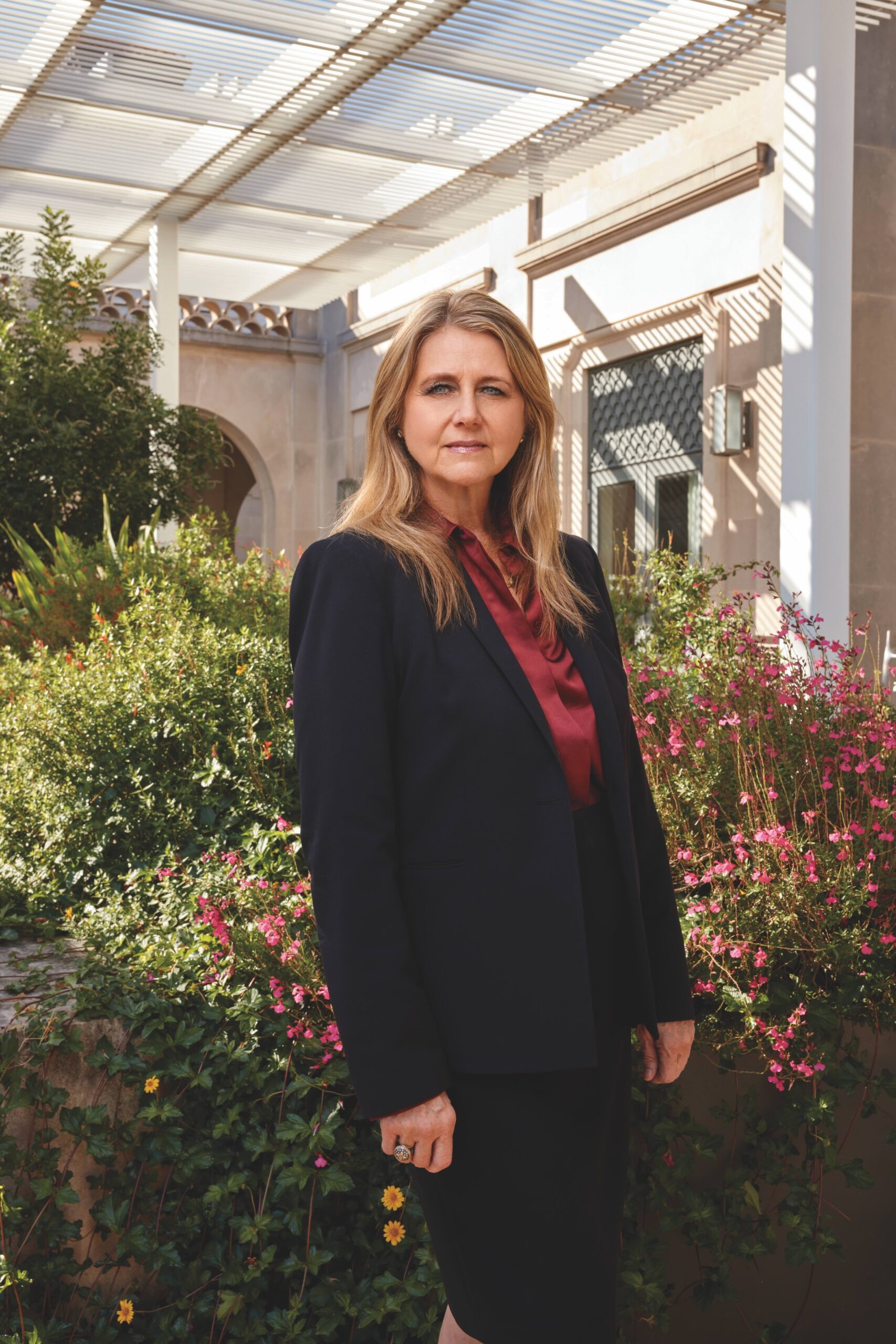
How Mindy Montford ’95 tackled Austin’s most notorious unsolved murders.
By Liz Anderson Hilton
Portrait by Michael Thad Carter
Halfway through Mindy Montford’s undergraduate senior year at UT Austin, someone brutally murdered four Austin teenagers. Big-city crime is common. Dallas and Houston had racked up 500–600 murders each in 1991. But Austin’s murder count that year totaled a mere 45.
On Dec. 6, 1991, the city added four more: Amy Ayers (13), Sarah Harbison (15), Sarah’s older sister Jennifer Harbison (17), and Eliza Thomas (17). The quadruple homicide, known simply as Yogurt Shop, remained unsolved for decades. But as fate would have it, the college student would become the lawyer championing its resolution in 2025.
No Leads
The Yogurt Shop victims were sexually assaulted, tied up, and shot in the back of the head before the killer set fire to the store, burning the victims and torching most of the incriminating evidence.
The investigation would be plagued by that lack of evidence, with more than 50 false confessions, four wrongful accusations, two overturned convictions, and the disconsolate passage of time. Normally, time works against answers. But in Yogurt Shop, it was the 34-year gap that eventually yielded enough advances in forensic investigation to finally connect the dots.
Noting the families’ pain, Montford says, “I wish it had been sooner.” But she reflects, “Yogurt Shop couldn’t have been solved before 2025. That was just the year for it.”
Taking on the Case
In January 2017, after being named First Assistant District Attorney for Travis County, Montford met with the family of the youngest victim, Amy Ayers. “They wanted Margaret’s [Moore ’72] assurances that she was going to continue looking into the case,” Montford says. That was when she and Angie Ayers, Amy Ayers’ sister-in-law, first considered what it would take to tackle cold cases systematically. Montford started the Travis County DA’s first cold case unit and, a few years later, the first statewide cold case unit at the Office of the Attorney General.
By 2021, Montford, now working through the OAG, stayed closely connected to the Yogurt Shop case. She talked with the victims’ families typically monthly and sometimes weekly. “And that’s since 2017,” she says. Taking on the case “was life changing. I didn’t know how life changing it was going to be. I was humbled. I was scared. I was excited.”
Heating Up
Though it was too early to know, the case began heating up in 2018 when amateur sleuths cracked the code on a new forensic science: investigative genetic genealogy. (See “Tracking Down Invisible Killers”.) Using the same technique that identified and led to the arrest of the Golden State Killer in the spring of 2018, Missouri investigators linked Robert Eugene Brashers, now dead, to two cold cases: a 1990 murder in South Carolina and a 1998 double homicide in Missouri. Though there was no evidence at the time linking Brashers to Yogurt Shop, his identification in 2018 proved pivotal for solving Yogurt Shop seven years later.
The first significant break in Yogurt Shop came in June 2025, when Austin Police Department Detective Daniel Jackson, whom Montford describes as the quintessential detective, noticed that the shell casing from the .380 caliber weapon used to shoot the victims was no longer in a national database. The National Integrated Ballistic Information Network (NIBIN) links gun crimes and shooters by matching unique markings on spent cartridge cases. Montford confirmed that the Yogurt Shop .380 casing had been in NIBIN, and that sometime before 2025, it had dropped out of the database.
In June 2025, when Jackson uploaded the .380 data into NIBIN again, he had a hit within 24 hours. The same gun had been used in another crime: an unsolved 1998 murder in Kentucky with a similar modus operandi to Yogurt Shop. Linda Rutledge had been raped, tied up, and killed with a .380 gunshot to the back of her head in a strip mall, and the crime scene was set on fire. Critically, the Kentucky investigators had a fully intact rape kit.
Closing In
The Yogurt Shop investigators now had a ballistics match to another crime with a similar MO. Could DNA evidence now lead to the killer’s identity?
In Yogurt Shop, APD investigators had been working with a Y-STR (single tandem repeat) of DNA recovered from one of the four victims. The Y-STR, carried only on the male chromosome, is helpful in rape cases where the DNA becomes mixed with that of the female victim. It isn’t an individual’s DNA profile; related men will share the same Y-STR markers. Because they are inconclusive and time-consuming, “not every jurisdiction will run manual keyboard Y-STR searches,” Montford notes. “Texas doesn’t,” she adds. “But Kentucky does. And so does South Carolina.”
That’s when Montford and Jackson caught their second big break. After asking labs and jurisdictions around the country for help, South Carolina law enforcement—running their first-ever manual keyboard search—connected the Yogurt Shop Y-STR markers to Robert Eugene Brashers, the man identified in 2018 as the killer in the 1990 South Carolina murder and in the 1998 double homicide in Missouri.
I didn’t know how life changing it was going to be. I was humbled. I was scared. I was excited.
Brashers Under Her Nails
Now, with 34 years of not knowing, pacing almost breathlessly toward an answer, Montford and Jackson knew that they needed proof that Brashers did it. Having his Y-STR type isn’t proof. Rather, it simply places him among a pool of possible perpetrators. Investigators decided to test the precious little DNA remaining—scrapings from under the fingernails of Amy Ayers. When Montford and Jackson heard back, Montford remembers the analyst saying, “I hope you’re sitting down. Robert Brashers is under her fingernails.” The Kentucky rape kit confirmed that Brashers had murdered Linda Rutledge, too, bringing his known murder count to eight, all women and girls, including a mother and her daughter.
As the families strained to come to terms with the answer at a hastily organized press conference last September, the victims’ families expressed a range of emotions: anger, relief, exhaustion, but mostly gratitude. Through raw, throat-catching emotion, Shawn Ayers, Amy’s brother, praised Montford. “Mindy has been there since the beginning, and yes, she told us face-to-face that she would never stop fighting and never stop helping us … [S]he never backed away from the fight and always gave us hope, not with her words, but with her actions.”
Answers
Though the killer is long since dead, Sonora Thomas, Eliza’s sister, made plain the value of an answer. “What I learned about myself in the past two days is that my brain was split into two. One part of my brain has been screaming, ‘What happened to my sister?’ And the other part kept repeating, ‘I will never know, I will die not knowing, and I have to be OK with that.’ On Saturday, [with the news that Brashers was responsible] those two parts of my brain started melting into each other. I realized how much energy I had used to keep them separate and to convince myself that I was OK not knowing.”
Yogurt Shop, Montford notes, was finally solved with good old-school detective skills laced with ballistics, DNA, genetic genealogy, rape kits, and law enforcement cooperation across states. Having worked together to start up two cold case units in Texas, Mindy Montford and the Ayers family are setting up a national nonprofit to address this country’s 300,000 cold cases. “Open the cold case boxes, please. Put the evidence in the databases. Run the rape kits,” Angie Ayers pleaded with law enforcement. With funding for cold cases largely dependent on grants, their new nonprofit aims at helping law enforcement do just that.
Yogurt Shop, and Montford, may just lead to answers for more families.