
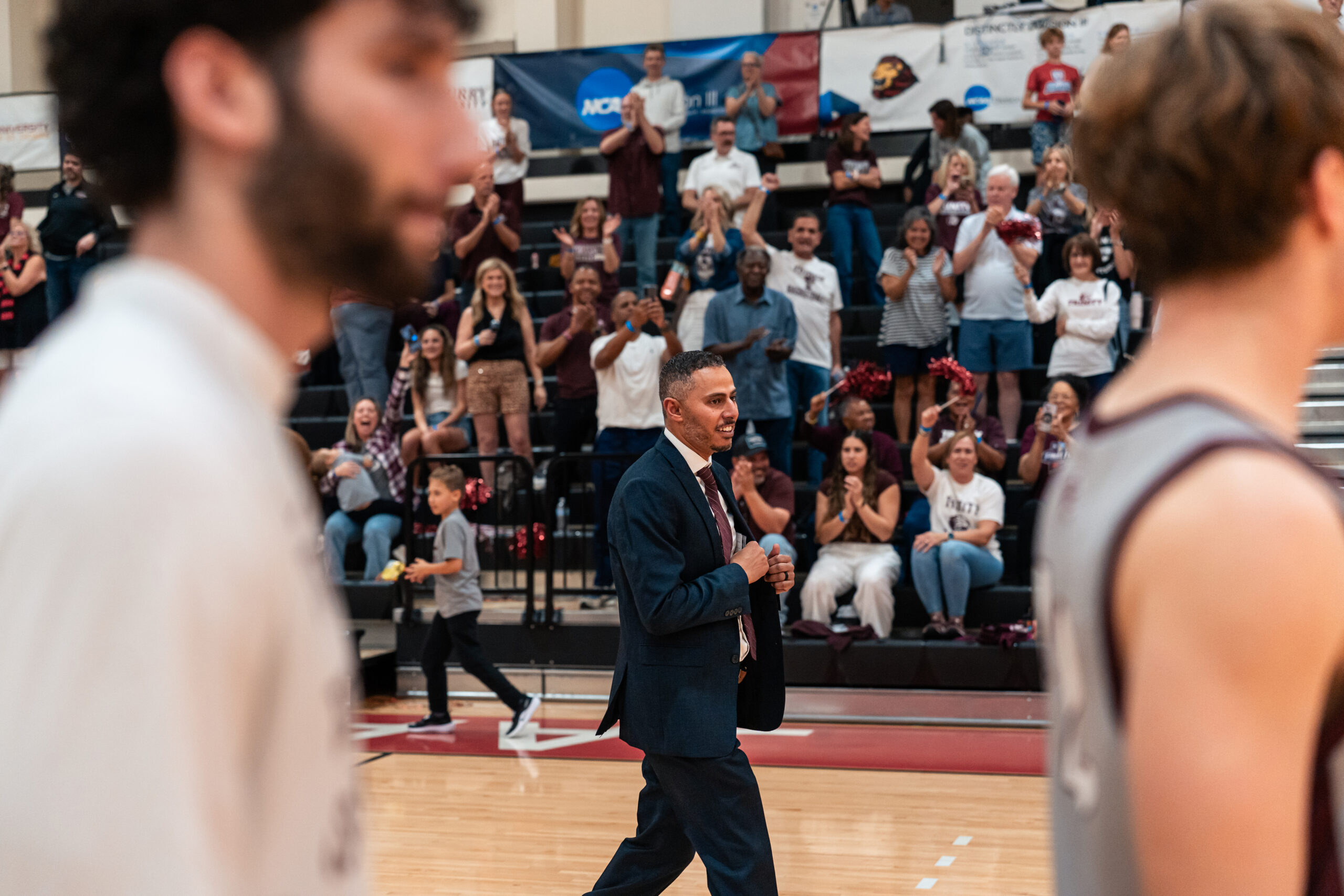
For years, Marwan Elrakabawy ’06 led a double life: days as an intellectual property attorney on high-profile cases followed by nights leading young men to victory on the basketball court. In 2019, he left working as a full-time lawyer behind, first for the head coaching job at Schreiner University in Kerrville, Texas, before becoming head men’s basketball coach at Trinity University in San Antonio in spring 2025, a dream come true for the lifelong basketball lover.
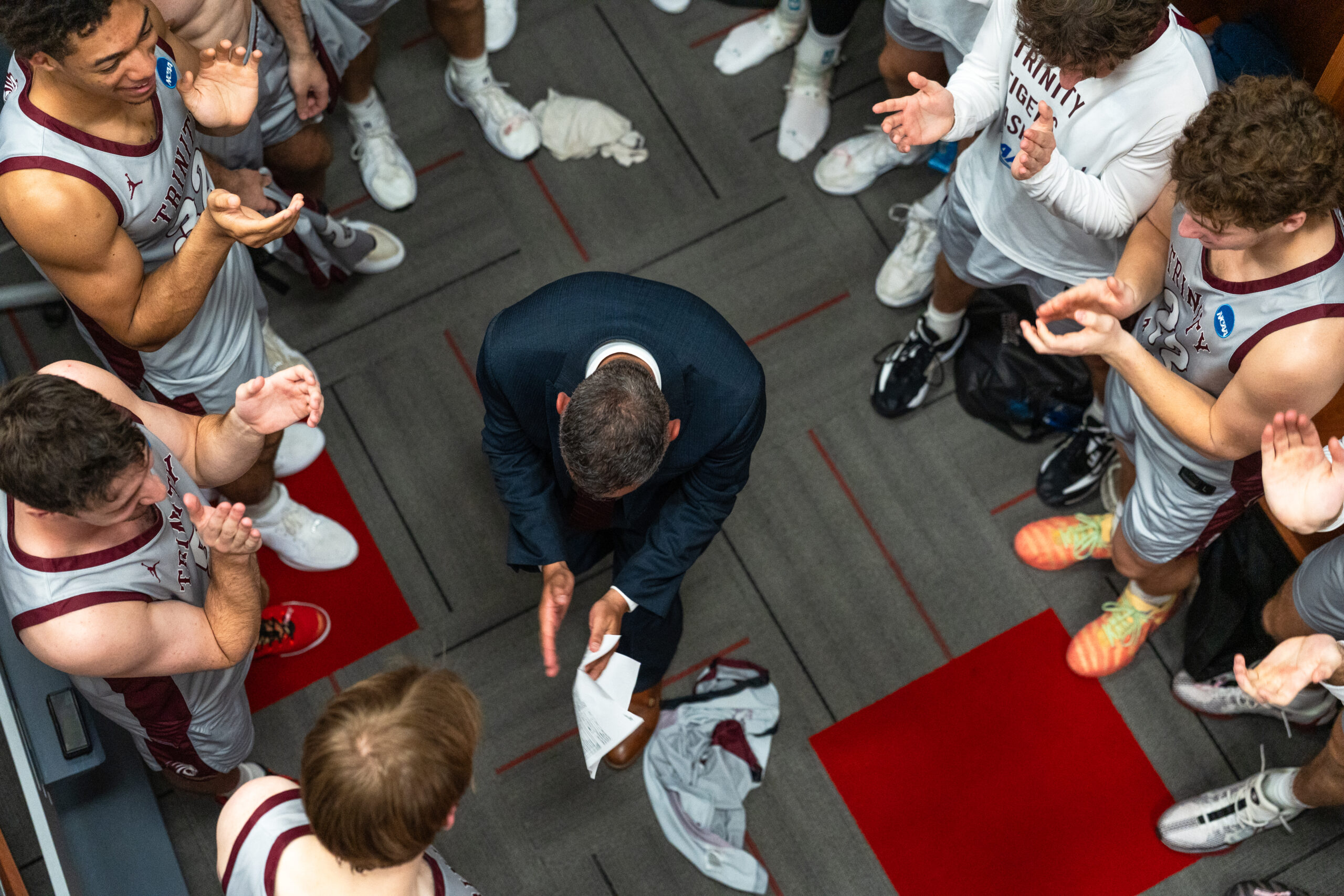
In Elrakabawy’s first season in 2025-2026 at Trinity, he led the Tigers to 22 wins and seven losses. The team got an at-large bid to the NCAA Tournament and won its first-round game, advancing to the 32nd round for the first time since 2022. Elrakabawy joins a small, but elite group of college basketball coaches who have also practiced as attorneys, including Pepperdine University’s Griff Aldrich.
Elrakabawy’s love of the game began when he emigrated with his family from Alexandria, Egypt, to Houston in the 1990s and basketball superseded soccer as his favorite sport. He played basketball with a grocery cart rigged to a fence and then in high school looked up to fellow Muslim Hakeem Olajuwon who led the Houston Rockets to back-to-back NBA championships in the 1990s.
Later, as an undergraduate student at The University of Texas at Austin, Elrakabawy studied computer science, enrolled in American Sign Language classes, and volunteered as a basketball coach at the Post Oak YMCA in Houston. Driven by the idea that both computer science and law break down big problems into smaller ones and create strategies for a solution, he joined his twin brother, Hassan Elrakabawy ’05, at Texas Law. Elrakabawy’s ASL classes helped him secure a volunteer assistant coaching role at the Texas School for the Deaf while in law school and beyond, ultimately paving the way for his coaching career. We recently caught up with him.
When you came to Texas Law, did you have any sense of what kind of law you wanted to practice?
I was open to anything. As a young law student, you’re seduced by the big-time constitutional arguments and Supreme Court advocacy. At one point, I thought maybe I’d be an appellate lawyer. But I kept getting encouraged by intellectual property law, because I had this background in computer science, and intellectual property lawyers typically have science backgrounds. So that’s what I did.
What was it like going through law school alongside your identical twin, Hassan?
Hassan and I overlapped for two years. He gave me a lot of practical advice and calmed my nerves about law school and what exams would be like. I did well in law school, and a big part of that was because of his guidance. He coached me through it. People always got us confused, and with quick interactions, we didn’t always correct people. Instead, at the end of the day we’d give each other messages people had given to the wrong brother.
Now, he’s a partner at Yukevich | Cavanaugh in Los Angeles focusing on products liability lawsuits. He’s always encouraging, sending long texts after games telling me what a great job I did. Both Hassan and my wife, Erin, have supported me along my career journey every step of the way. I wouldn’t be able to do what I do without them.
It’s wonderful to have that support. At Texas Law and into your first job after graduation at Akin Gump in Austin, you stayed connected to basketball through volunteering. How did that take shape for you?
When I got to law school, I already had basketball summer camp coaching experience under my belt. It occurred to me that the Texas School for the Deaf, where I’d previously volunteered as a teacher’s aide with a first grade class, must have a basketball team. I had a bit of an advantage, because how many people know sign language and have coaching experience? I spoke with the athletic director and started volunteering, helping with drills, then game planning.
I ended up having an eight-year relationship with the school, for most of the time as a high school coach, but also coaching the junior varsity team and middle schoolers. Toward the end, I was working at Akin Gump. I’d get to work early, then leave at 2:30 p.m. to coach, often swapping my office wear for athletic gear in my car to save time. Basketball was fun. I never thought it would end up being a career. But I grew and matured as a coach, and my time with the school was life-changing—it ended up leading to my first college coaching job. With coaching, you consistently touch a level of joy you can’t in any other way. There’s energy and fire in moments of the team struggling, rallying together, and winning.
With coaching, you consistently touch a level of joy you can’t in any other way. There’s energy and fire in moments of the team struggling, rallying together, and winning.
That must be incredible. After law school, you had two clerkships—for a district court and the 5th U.S. Circuit Court of Appeals—and then joined Akin Gump in Austin. What were some standout cases from your time there?
Having those very different experiences gave me a good overview of the judiciary. I was at Akin Gump in Austin for six years. I worked on a big trademark case for Coca-Cola Co. Pepsi and Coke were in litigation around the Simply line—Coca-Cola’s Simply Orange Juice and Simply Lemonade, and Pepsi’s Trop50. The question was whether the packaging looked similar enough to create confusion for shoppers or dilute Coca-Cola’s trade dress, its distinctive look and branding. From a branding and consumer behavior standpoint, it was almost like the Super Bowl of trademark litigation. From Coca-Cola’s perspective, Pepsi was encroaching on the look and feel of the Simply brand.
After that, I started noticing how little attention you pay at the grocery store when you just grab something because it looks familiar. Companies pay millions and millions of dollars to try and develop and protect that consumer habit.
Returning to coaching, your big break into college basketball came at Gallaudet University. How did that opportunity come about?
One summer, the head coach for Gallaudet University in D.C.—which caters to deaf and hard-of-hearing students—and some of his players were at TSD. We got into a conversation, and he asked me if I’d ever thought about coaching college ball. I told him I’d love to, but never thought I’d get that kind of opportunity. He asked me to come to D.C. to help his team as assistant coach. At the time, I was married, had a 10-month-old, and was working at Akin Gump. It was a great opportunity, so I ended up leaving the firm.
Erin, who’s also an attorney, could work remotely, so we made it work with trips back and forth. That part of it was hard. One time Gallaudet won a big home game against the No. 1 team in our league, and everybody went crazy in the locker room, but then I went back to my dorm room alone because my family had gone back home. It was depressing, because there was nobody to share it with.
After a year, you returned to law. How did coaching continue to stay in your life?
I joined Norton Rose Fulbright in Austin doing intellectual property law, and I was there for four years. One of the most interesting cases I worked on involved reflective insulation, the material used in building attics and roofing systems to help reflect heat and regulate temperatures, keeping spaces cooler in the summer and warmer in the winter. It was my first time going to trial, and it felt a lot like being on a sports team—you prepare, play your game, then wait for the jury to tell you whether you won or lost. We won the case and celebrated like crazy that evening.
I still wanted to keep coaching though. I reached out to St. Edward’s University in Austin and spent the first year helping them out. That led to an opportunity at Southwestern University, which led to a part-time coaching job at Schreiner University. I was pursuing this double life again. As I made progress with my basketball career, it was going to be incompatible with continuing to practice law.
It was my first time going to trial, and it felt a lot like being on a sports team—you prepare, play your game, then wait for the jury to tell you whether you won or lost. We won the case and celebrated like crazy that evening.
So, how did you ultimately land the coaching jobs at Schreiner and then Trinity?
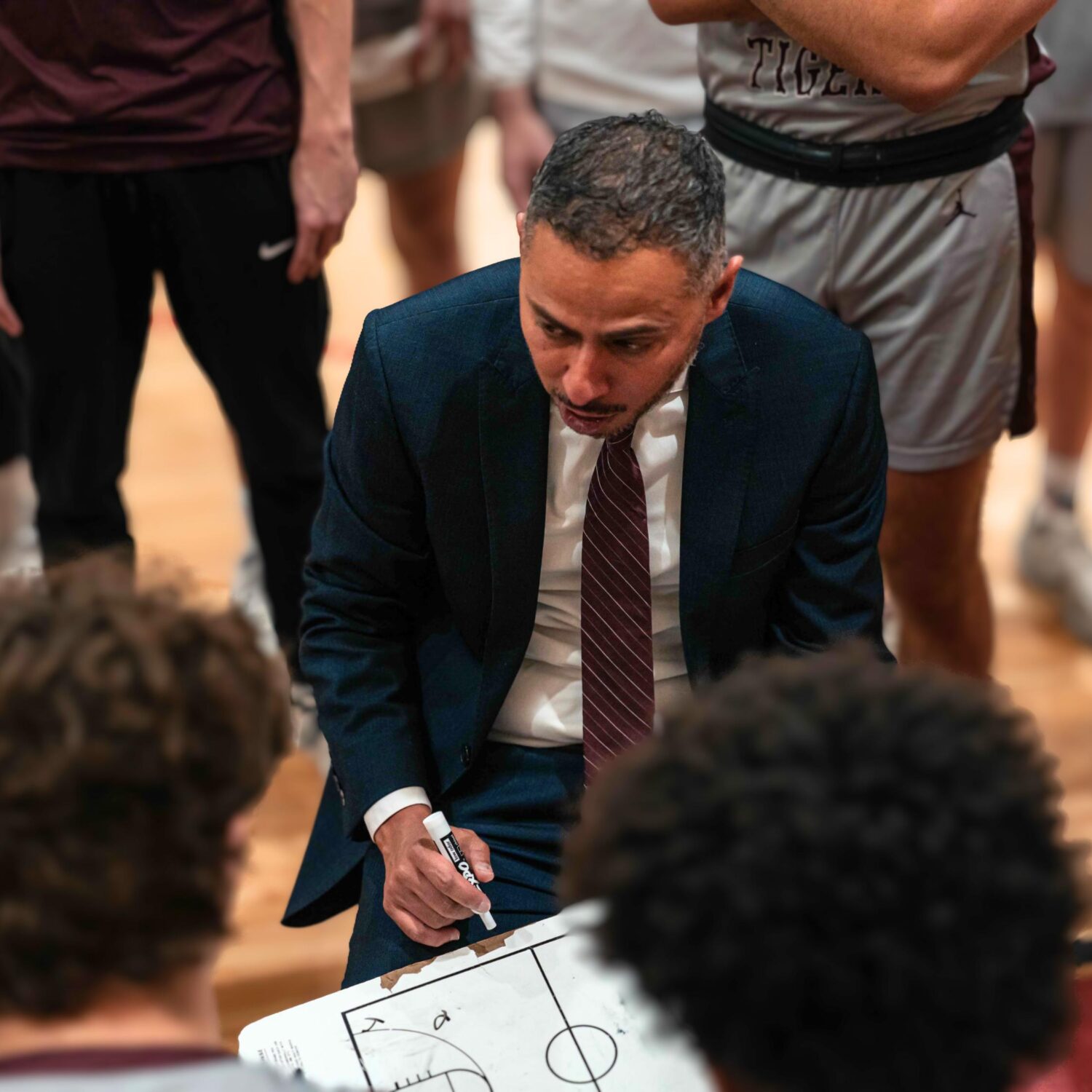
After a couple years as an assistant at Schreiner, the head coach I worked with, Connor Kuykendall, moved on to a different job. Fortunately, Bill Raleigh, the athletic director at Schreiner, gave me an opportunity to take over the program. At that point, I knew I had to make the decision to step away from full-time lawyering and I moved into a part-time role. It was difficult leaving the high-quality people I worked with at my firm. But part of me always knew that if I could find a way to make a living coaching basketball, that it would be the ultimate life hack, the dream. I know some people feel that way about working in law, too.
At Schreiner, we had some amazing success, including winning a 2023 conference championship and going to the NCAA tournament for only the second time in the school’s history. Last year, the job at Trinity opened up. That 2023 championship final was against Trinity, and because they were in the same conference as Schreiner, I had a lot of familiarity with the school and area. I reached out to a contact I knew at Trinity, the head women’s basketball coach Cameron Hill, and was able to land an interview. Fortunately, I was able to secure the job. Trinity is an amazing place to coach, with excellent resources and facilities.
How has your Texas Law experience shaped your coaching style?
My law school education was so helpful in terms of thinking analytically and applying logic to whatever you’re doing. There are different ways to coach basketball, and I’ve come at it from a much more analytical framework because of Texas Law.
We think about the most efficient way to score baskets and focus on trying to generate a lot of shots around the rim. And then defensively, it’s about how we can prevent the opposing team from taking shots close to the basket and drive down their scoring percentage there. It’s like law school: you’re thinking about what’s the most favorable terrain to be on to win a case. I still draw upon lessons I learned at UT.
My law school education was so helpful in terms of thinking analytically and applying logic to whatever you’re doing. There are different ways to coach basketball, and I’ve come at it from a much more analytical framework because of Texas Law.
Very interesting! Do you foresee a possible return to the law one day?
Ideally, I’d find a way to be involved on a consulting basis and keep those muscles going. But when you become a head coach, it’s hard to divide your attention. So legal work isn’t practical right now. Maybe in the offseason or on a pro bono basis. I also tell my prosecutor wife that I could represent pro se plaintiffs—who are representing themselves—against her, which is obviously a joke because there would be major ethical issues with that!
And finally, when you’re not coaching, what do you enjoy doing?
As a Texan, I’m into smoking briskets. From time to time, I get the wood pellets out and get to work.