
On Sept. 12, 2025, Texas Law hosted The Precursors, a group of African American alumni who share the distinction of being the first Black students to attend The University of Texas at Austin, for a commemoration of the 75th anniversary of Heman Sweatt’s enrollment at the law school, a historic event that integrated the university.
Among the speakers were President Jim Davis, Dean Bobby Chesney, Precursors president Cloteal Davis Haynes, and Gary Bledsoe ’76, longtime president of the Texas NAACP.
Bledsoe’s remarks that day relayed rarely told anecdotes about the state of the NAACP during the 1940s and reminded listeners of those “unsung heroes” who quietly supported Sweatt, his attorney, Thurgood Marshall, and the legions of activists working to change the country’s segregationist laws and policies.
With his permission, we share below an abridged version of Bledsoe’s speech from that day. You can watch the commemoration, including Bledsoe’s full remarks, on the Precursors website.
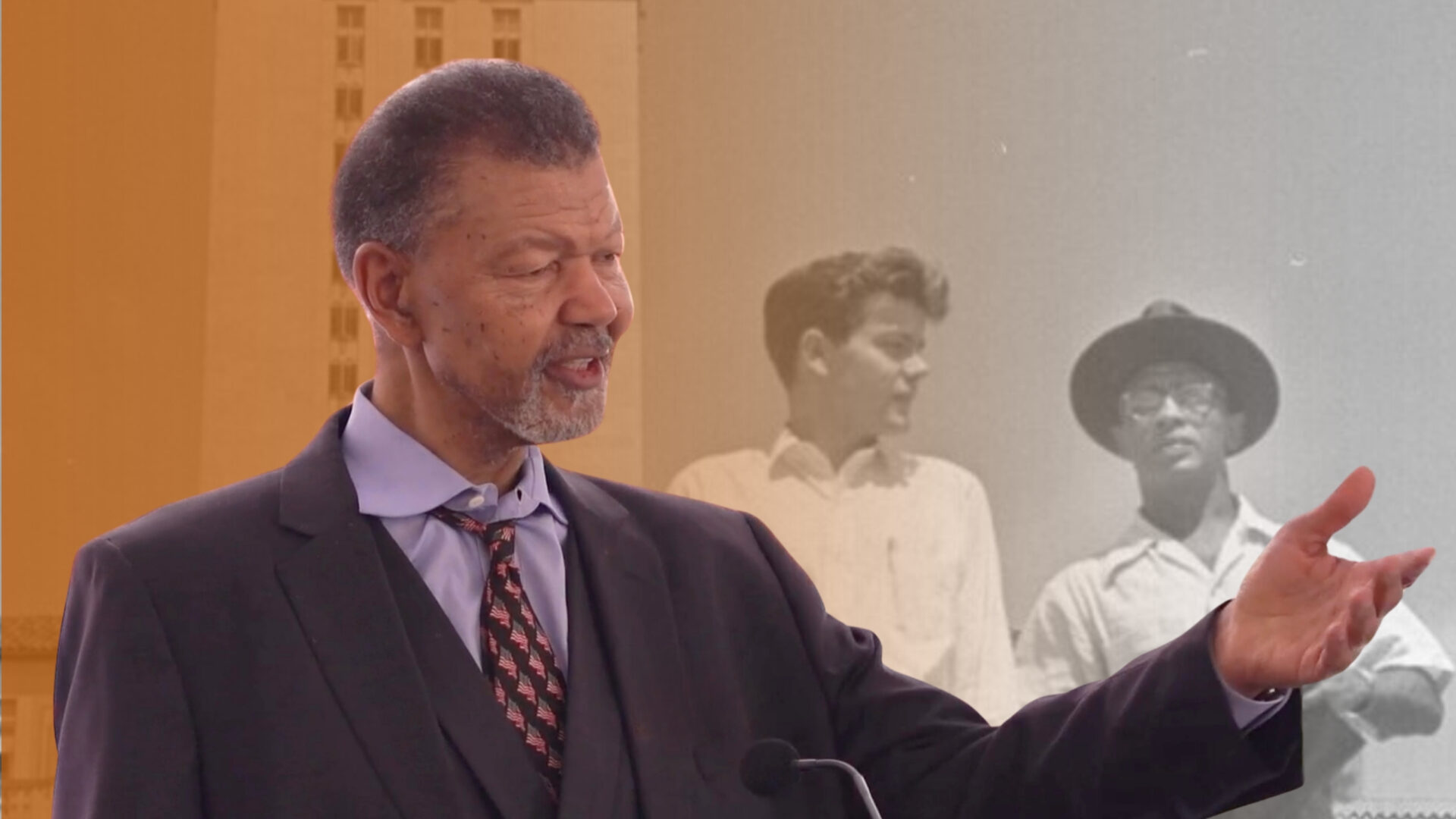
Gary Bledsoe
My charge today is to give you a small idea of what was occurring on the campus at the time that Heman Sweatt’s case developed, to the selection of Sweatt as a plaintiff, and what occurred at that time with the NAACP.
There are a couple of important factors to note. In 1936, Thurgood Marshall and Charles Hamilton Houston had won a case involving the University of Missouri. In that case, Lloyd Gaines was the plaintiff, and they prevailed. But Lloyd Gaines disappeared off the face of the earth, and Marshall and Houston could never find him. Though they won at the Supreme Court, they could not implement their remedy because they did not have a client.
And to this day, no one really knows what happened with him, though there were many rumors. The last he was seen was at a YMCA in Chicago and the NAACP undertook an incredible investigation in trying to locate him, but they never did.
So, what became front and center with the NAACP was the need to select the right person to be able to carry the standard for additional cases. For example, they filed two cases against the University of Oklahoma and identified older plaintiffs who were more established and less likely to disappear, and that had the kind of inner stock to deal with all that you would have to endure if you’re going to be a named plaintiff during that time, in that time period.
Lulu White, a woman from Dallas and who was a mainstay of the NAACP in Texas, opened up different avenues for finding plaintiffs here in Texas, and that included Heman Sweatt.
Briefly, about Lulu White: The book “Showdown,” about the Supreme Court confirmation of Thurgood Marshall, goes into detail about her friendship with, and influence on, a young WPA administrator by the name of Lyndon Baines Johnson. It was through that relationship that Thurgood Marshall met Johnson and developed a relationship that led to his selection for the Court. So, you never know what kinds of circumstances will exist that allow you to develop and have relationships that will make a difference later on!
Back to the Sweatt case. What you must understand today about the NAACP then is, we weren’t a large organization that had a huge budget that could fund litigation. Thurgood Marshall came here, to the organization that I now head, and met with the leaders and said, “This is the amount of money we’re going to need to have this case. How much can you do San Antonio? How much can you do Dallas? How much can you do Houston?”
That’s how we did litigation.
They also thought that if they were successful with Sweatt, somebody would have to help him out. To do that, they created an all-white chapter of the NAACP on the University of Texas campus, and that all-white chapter was there to help Thurgood Marshall through the way, to assist them in the success of their effort.
There are a lot of heroes like that, that sometimes we don’t know about. For example, in the University of Oklahoma case, Thurgood Marshall sat down with the president of the university very quietly, and the President said, “What do I need to put on this piece of paper to help you succeed?” That’s a story not known in greater America, but you had a good person there who understood what right was. He couldn’t tell the world that he supported the NAACP’s efforts, but he could put on that paper what Thurgood Marshall needed to litigate the case.
The crucial thing about the Sweatt case was, that defining moment when Marshall thought, we’re going to do something different. Sweatt was the first case where they went after the quality of the education provided by the institution. All the others were about, “you don’t have anything in this state, and our students have to go out of state.”
But in challenging the quality of the education, there were more of those unsung heroes. Page Keaton, for example, who was just a professor at the time, helped Thurgood Marshall. One ironic things is that Thurgood Marshall later became good friends with Joe Greenhill, who tried the Sweatt v. Painter case on behalf of the State and who later became the Chief Justice of the Texas Supreme Court. You see, Thurgood Marshall knew how to do things in a bit of a different way and understood the value and the importance of relationships.
Now, I’m honored to say on the 25th anniversary of Sweatt’s admission, in 1975, I was a student here and I was serving on the Board of Governors at the law school. We arranged to bring Heman Sweatt here and we had a standing room only event for him in Tom Clark lounge. It was such a compelling time to hear him, because he talked again about the heroes that helped him.
He talked about his first day as a student here on the campus. He had a research and writing assignment that we all knew about on the first day. After he finished his research and writing assignment that night, he was about to leave, and some kind white students grabbed him. They said, “no, you can’t go out there.” He looked outside, and he saw the torches and the folks marching and protesting him being there.
He slept in the law school that night, getting up at about 4 a.m. to leave. The parking lot was over where the old bookstore is, right across from the law school. He said that was the longest walk in his life. He said that he knew that a shot would ring out. It did not, but when he got to the parking lot, there was only one car left. It was his, and he presumed that they had deduced that that was his car. All four tires were slashed.
He had to walk home to East Austin that night.
We owe a lot to Heman Marion Sweatt. He’s made so much possible for us here in this state and here for all of us in this nation. And I want to thank The Precursors for continuing to allow him to be alive, as we need to continue to proliferate his story so people will understand the importance and the sacrifice that people like him made, and to continue to bring about the acknowledgement of his legacy and its importance.
To learn more of these stories, there are books I’ll recommend. Michael Gillette’s history, “The Texas NAACP, 1936 to 1976,” and Gary Lavergne’s “Before Brown: Heman Marion Sweatt, Thurgood Marshall, and the Long Road to Justice,” which was published by UT Press. I don’t agree with Lavergne’s thesis, that Sweatt v. Painter is more important that Brown v. Board of Education, but I love his work. I can’t give him that, though.
Thurgood Marshall himself said the most important case he ever handled with Smith v. Allred, and I think that is significant. But read Gillette and you can see what was occurring on the campus, you can see the heroes, such as the all-white student chapter. It really made a difference in the lives of other people, and we need to lift those people up, identify and see who they are, and where they were.
And you can learn more about Lulu White and amazing women like her through Merline Pitre’s “Black Women in Texas History” and “Southern Black Women in the Modern Civil Rights Movement.”
See the entire celebration of the 75th anniversary of Sweatt v. Painter and Heman Sweatt’s enrollment at Texas Law including Gary Bledsoe’s full remarks.