
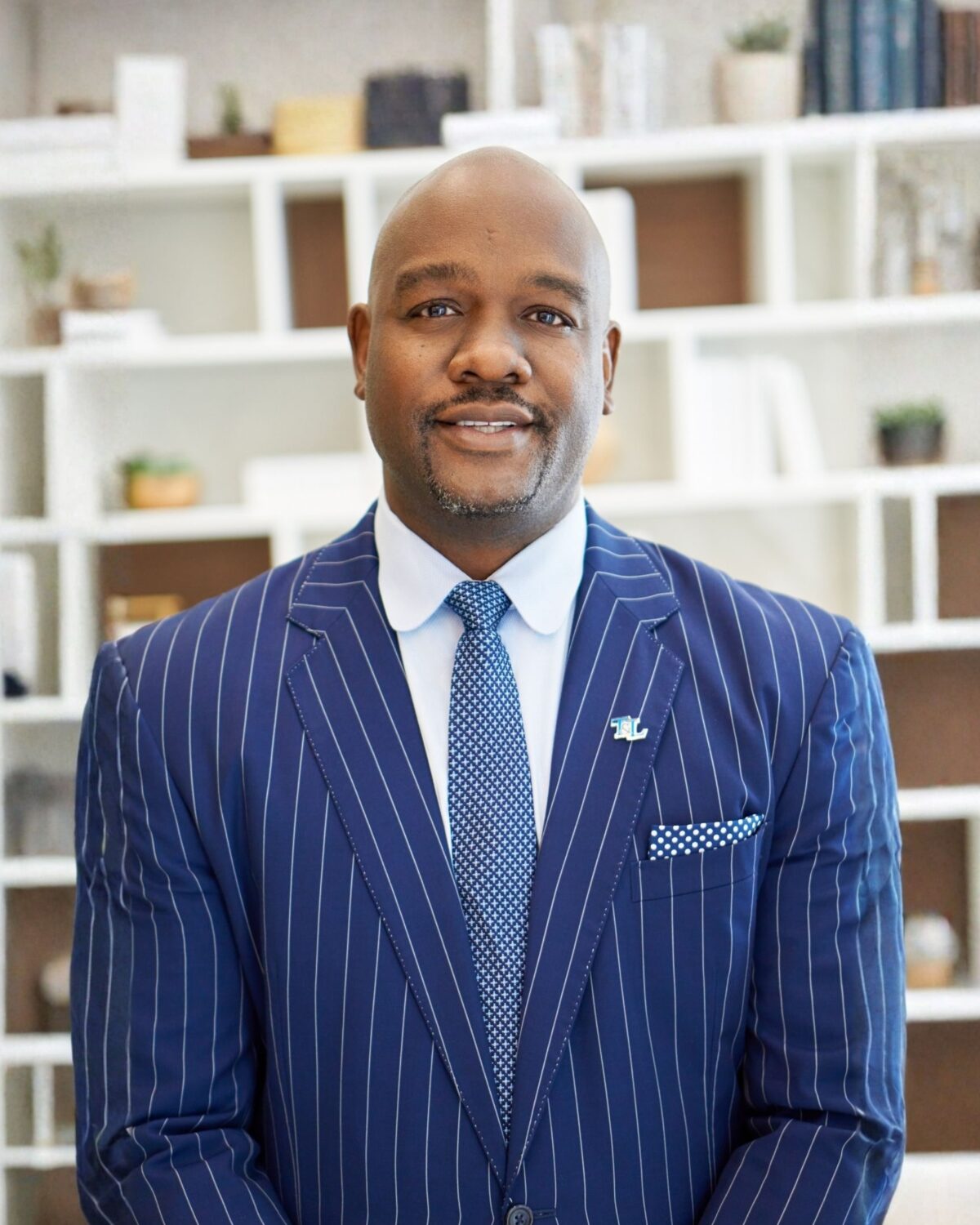
Across a 25-year career, Marlen Whitley ’01 has built a corporate law practice around moments of change, when companies are growing, restructuring, or navigating new regulatory ground. His work has taken him from a legacy insurance institution to an emerging cannabis business, and from global law firms to a boutique practice handling high-stakes transactional matters.
Whitley’s first job out of law school was at Clark Thompson Winters in Austin. He later worked as a senior attorney at financial services company USAA, advising the board of directors and internal working groups on corporate governance matters. He’s also been a hiring partner at international law firms Reed Smith LLP and Thompson & Knight LLP in Houston, and at Reed Smith, he became the firm’s first executive director of diversity recruiting, leading efforts to recruit diverse lateral partners and associates. He later served as senior counsel at Ghost Management Group LLC, doing business as Weedmaps, where he focused on securities law compliance, co-led corporate financings and capital raises, and supported business operations.
As managing partner of Townsend & Lockett LLC’s Los Angeles office for the past four years, Whitley has guided buyers, sellers, and investors through mergers and acquisitions while advising venture and private equity clients on fund formation, compliance, and strategic capital deployment. Whitley’s diverse legal work has ranged from helping a principal of a private equity firm buy a minority stake in the Houston Texans, to supporting a venture capital fund that invests in tech-focused startups.
We caught up with the double Longhorn, who earned his undergraduate and law degrees at The University of Texas at Austin.
You came to Texas Law after studying African American studies and history as an undergrad. At the Law School, were there professors or classes that had a lasting influence on your path?
I credit my Contracts professor, David Sokolow, with my interest in going into corporate and transactional law. He was so outgoing and engaging, had such passion for the topics, and made the class incredibly interesting. He cared deeply, took an interest in me, and helped position me on the career path I wanted to pursue. I’ll never forget that. I’ve kept in touch with him over the years, and when I started practicing at Clark Thompson Winters, he’d send me handwritten notes from time to time just checking in.
During your career, you’ve moved between Big Law, in-house roles, and now back into firm leadership. Looking back, how did each transition reshape the way you think about client relationships?
Over the last few decades, my perspective on my practice and client service has changed significantly. As a baby lawyer at Clark, Thomas & Winters, I learned that your first clients are the partners you work with. You’re beholden to the work and assignments they give you, and to instill confidence and ensure a continued pipeline of work, you’ve got to deliver great client service. Honing my craft with partner mentors helped me deliver when I started interfacing directly with clients. I had more confidence. Then, when I went in-house, the business unit was the client. It was more of a partnership, and I had to think even more strategically. Now, in private practice again, I see myself as an extension of the client. We try to share in the risks and rewards.
As the father of three creative adult and teenage kids, you’ve drawn parallels between building a law and performance career. How do those two paths align in your mind?
I’m the least artistic person you’ll ever meet. But I was blessed to have some incredibly talented artistic kids. My youngest son is in his second year of the Houston Ballet’s professional program. I’ve seen his role go from small bit pieces to main characters, and that progression is true of law, too. As you’re learning your craft, you get smaller roles. But as you get more comfortable, confident, and experienced, you can be cast for larger ones. Whether you’re doing litigation or transactional work, that’s the beauty of practicing law—you earn your stripes, and then you can “audition” for larger roles.
Whether you’re doing litigation or transactional work, that’s the beauty of practicing law—you earn your stripes, and then you can ‘audition’ for larger roles.
So, at this point in your career, what is it about the boutique firm model that feels like the right fit?
It’s more bespoke. I’m at a point in my life and career where building and sustaining a practice is the main focus. In Big Law, I was charged with so many responsibilities. I served as hiring partner and as executive director for diversity recruiting. I spent a considerable amount of time on administrative management tasks and tried to counterbalance that with practicing law. Now that I no longer wear those titles, I can focus exclusively on practicing law. It gives me a better perspective on how I want to spend the back nine of my career—advising and working with clients.
Working in a boutique setting also means being closer to regional business cultures. As partner-in-charge for the Los Angeles and Houston offices, how do differences between markets shape corporate practice, and what should young lawyers understand about working across them?
Every market has its own unique personality and industry drivers. The real challenge for younger lawyers is deciding what type of work or scope of work you’re interested in. That will help you select a market. I used to describe my practice as industry agnostic because working across retail and manufacturing, oil and gas, and entertainment, you get a chance to see a variety of transactions and interface with different types of clients along the way. I prefer that because it keeps the spice in life. I really appreciate the variety. Taking the time to learn in-depth about industries you’re interested in gives you the confidence to be able to work across markets.
Being in Texas, and Houston in particular, played a distinct role in shaping your practice early on. How did it broaden your skill set?
When I worked on deals with lawyers in New York or Chicago, many were specialized. So, they were exclusively a mergers and acquisitions lawyer or capital markets lawyer. But being in Houston, I was cross-trained. I got experience in corporate finance and capital markets, initial public offerings, mergers and acquisitions, and general corporate governance. It was incredible exposure, not only to work on all of those types of deals, but also to lead and play significant roles in the transactions. To me, that’s unique to practicing in a market like Houston. You’re not siloed as being only a finance lawyer or only a capital markets lawyer, and as you grow you’ve got options. That makes you tremendously marketable when you’re deciding how you want to shape and grow your career and practice.
A major part of corporate practice involves developing and sustaining client relationships. How did you learn the business development side of the job?
Business development came easier to me because I’d done a lot of networking. As an undergrad, I served as student body president, interacting with the UT System Board of Regents. Being a 21-year-old student, talking to people from different walks of life—with careers, families, 401(k)s, and vacation homes—was a skill I had to learn. The more comfortable I got, the easier it was to walk into a room, introduce myself, tell people about what I do, listen to them, and develop some type of rapport, and use that as the foundation for building a relationship.
Young lawyers need to know that to build a practice, most people will have to build a client base from the ground up. You’re going to have to sell yourself and market what you do. Let people know the types of deals and transactions or litigation matters you’ve worked on, the role you had, the outcome, and even strategies and how you thought about things. You’ve got to be prepared to explain it in a way that makes sense, concisely, without legalese.
Positioning yourself as a problem solver is what keeps clients coming back.
Then, once a relationship is established, how do you think about demonstrating value to clients?
When you work with clients at a boutique level, you’re really in a partnership with them. It’s about positioning yourself as a stakeholder in their outcomes, helping them problem-solve and handle challenges that arise around their transactions. That often requires deeper digging and thinking creatively. Positioning yourself as a problem solver is what keeps clients coming back.
Over time, have you noticed shifts in what clients expect from their lawyers, particularly around value and service?
Clients expect premium results and deliverables. I don’t think that’s changed. But I do think clients today are much more focused on getting value for what they pay. That means you’re not acting strictly as a service provider, invoicing them at the end of the month for work done. Instead, you’re acting like a stakeholder in the business and providing value and services outside of billable hours. That might mean keeping clients apprised of changes in the law and regulations that affect their businesses or doing in-house continuing legal education. It’s really about being proactive and helping clients understand and navigate the landscape in which they’re operating.
You’ve worked on headline-grabbing deals, but much of corporate law happens far from the spotlight. What do you think distinguishes excellent lawyers on everyday transactions?
Going back to the theater analogy, if you’ve got one line in a play, you’ve got to deliver it like you’re the main character. You can’t wait until you get a main-character job to deliver a main-character performance. The same is true for practicing law. The everyday deals might not be as glamorous or grab headlines. But with respect to the client and what the client is trying to build, they’re critically important. Honestly, it’s often the smaller things that matter more. You have to place the same level of importance and care on deliverables for everyday transactions as you would on a headline transaction.
If you’ve got one line in a play, you’ve got to deliver it like you’re the main character. You can’t wait until you get a main-character job to deliver a main-character performance.
Care and preparation seem to be consistent themes in your work. For Texas Law students interested in corporate practice, what experiences or habits most clearly signal readiness to clients, beyond grades or firm pedigree?
Understanding the industries you’re working in is critically important. It really behooves you to read up on them, which requires devoting time outside of billable hours. When I was at Weedmaps, we took field trips to the farms and dispensaries. Seeing how everything worked gave me insight into the risks and really helped me when I was drafting documents or agreements between parties. Being able to immerse yourself in the industry is a huge boon.
Outside of your professional work, what do you enjoy spending time on?
My creative outlet is cooking. I find it therapeutic and do almost all the cooking at home. My friends joke that I should open a restaurant or that I missed my calling as an executive chef. During the pandemic, I considered buying a food truck. Now, I’m not sure about that, but I could see myself owning a restaurant or lounge where I can curate a menu.