
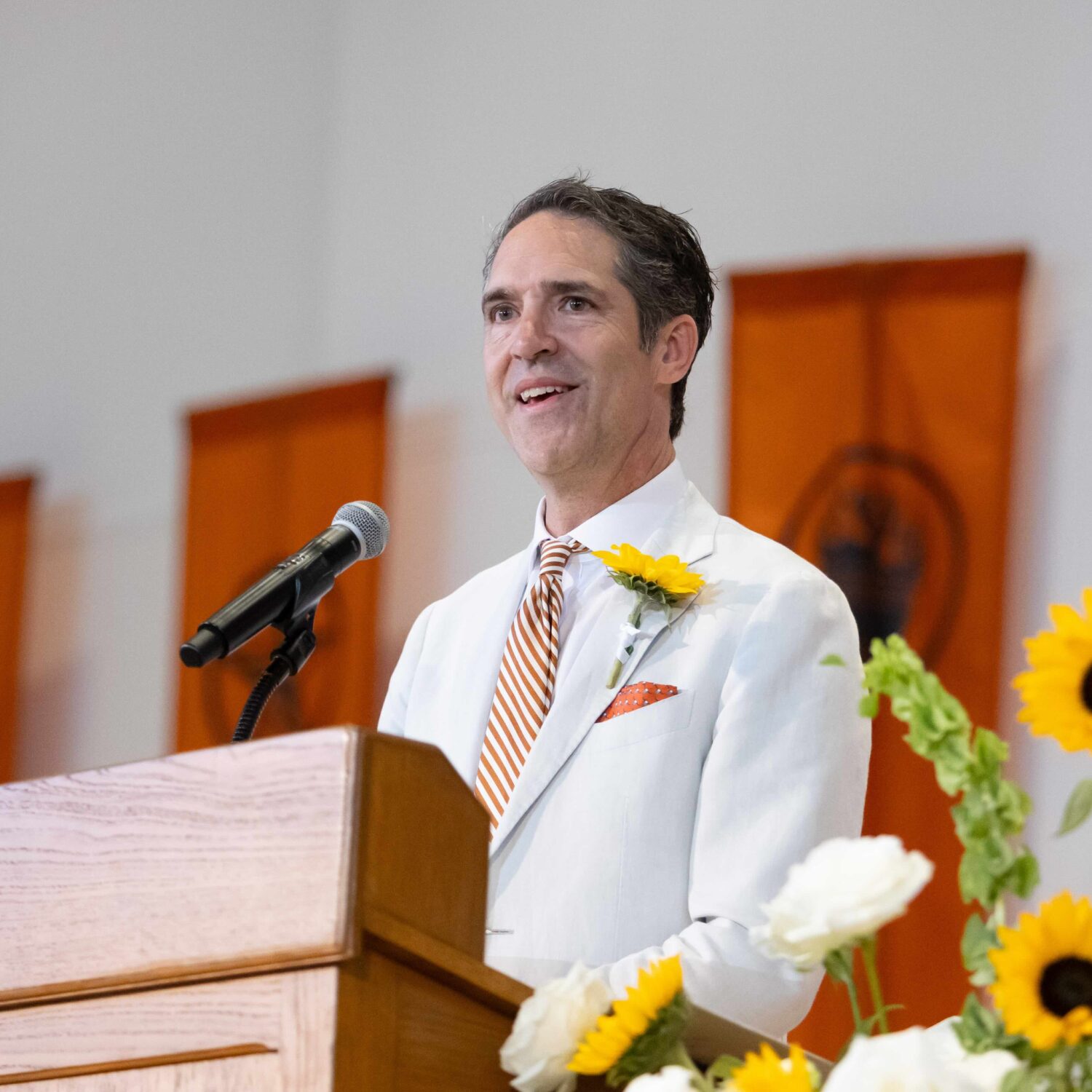
“This is the first time this class has all been together in one place since your orientation,” said Dean Bobby Chesney, addressing the Class of 2026 and their family, friends, and alumni supporters at the law school’s annual commencement exercises on May 9 at the Gregory Gym on the UT Austin campus. “And I told you then that in a thousand days we would meet here and that you would be changed.”
He was almost right. It was exactly 999 days between the start of the 2023 welcoming activities and this year’s Sunflower Ceremony. But he nailed the part about transformation:
“I pointed out that your life was on a collision course with future people that you one day would know as your clients—people who would depend on you. The path of your life has been drawing ever closer to theirs over these past thousand days and you’ve put all your energy into being ready for those clients when the time comes. And now, you’ve done it. You’ve acquired these remarkable capabilities. The ability to analyze, to argue, to research, to communicate. I know you’ll use these abilities wisely and generously. You’ll be a blessing to your society — the society that helped make these things possible for you.”
After welcoming remarks from the dean and keynote addresses from class president Holly Gray ’26 and College Football Hall of Famer and former Longhorn football coach Mack Brown, 262 Juris Doctor candidates and 24 Master of Laws candidates crossed the stage, received sunflowers from assistant deans Lauren Fielder and Elizabeth Bangs, and then were showered by a storm of confetti and applause before returning to the law school for an exultant party.
Below are transcripts and video of the two keynotes speeches, and photos of the event. You can learn more about the unique history of the Sunflower ceremony, or explore the achievements of the Class of 2026 in these earlier stories:
- End of Year Awards Honor Excellence
- Law School Grads Pursue Careers as Vast as Texas
- Prestigious Honor Society Welcomes Newest Members
- Advocacy Program Enjoys Unprecedented Success
- Class of ’26 Student Spotlights
Remarks of Holly Gray, Permanent Class President
Tyler, Texas, native Holly Gray graduated summa cum laude from SMU with a bachelor’s degree in psychology. She will join Vinson & Elkins in Dallas.
Holly Gray ’26: “We Did Not Do This Alone”
-
Good afternoon, everyone. Thank you, Dean Chesney, Dean Bangs, the incredible faculty and staff at Texas Law, and the family and friends who are here today to celebrate the Class of 2026. It is an honor to speak to you today — and an even greater honor to not have to follow the legendary Mack Brown.
If you were to ask each of us what these last three years were like, you’d probably get a hundred different answers. Intense. Transformative. Exhausting, but somehow fulfilling. But looking back, I think there’s one thing we can all agree on: none of us got here alone.
From our first day of orientation, we were welcomed into a community that is uplifting, encouraging, and grounded in a pretty simple idea: at Texas Law, we help each other. After hearing horror stories from other institutions — or maybe just watching Legally Blonde a few too many times — we came in expecting that cold calls were meant to embarrass us and that there was a competitive culture inherent in law school. But we quickly learned something else. UT is different. Not simply in the academics, the opportunities, or our national reputation, which are all outstanding, but it’s the people who show up for each other in the big moments and the small ones.
On the first day of our second semester of 1L, one of our classmates’ apartments flooded. Not just a small leak — real damage. The kind where you’re told to move out immediately. He lived alone and needed help, so he sent a message to our section group chat — the very people he was in direct competition with for grades on the curve. But without hesitation, people showed up. Despite the chaos of 1L and a new semester, people dropped everything. They packed boxes, carried furniture, and made sure he didn’t have to go through something overwhelming by himself.
What makes that moment so meaningful is that it wasn’t unusual. It was just the biggest example of what we had already been doing for each other. We showed up in the everyday moments too. We sent messages in GroupMe reminding each other what page we were on in Torts. We played witnesses for our classmates competing in mock trial. We eagerly attended the first day of our last semester to welcome back our friends who had studied abroad the previous fall. We made law school not just manageable, but actually fun.
Whether it was flag football games — where our competitiveness far exceeded our athletic ability — or bar reviews where we convinced ourselves we were taking well-deserved study breaks and could absolutely make it to 9 a.m. Property the next morning, those moments mattered. They’re a big part of why we’re here today.
And this community didn’t just show up for each other — it showed up everywhere. The Class of 2026 swept national competitions. The first class of the Law and Business Program graduates today after completing robust studies in the foundations of corporate law, uniquely preparing them to enter careers as transactional lawyers. We attended the last Hex Parte ever — that’s a Halloween party sponsored by our student government, for those who didn’t know. We made our own paths in law school, approaching this difficult process in different ways, from different points of view: veterans, first-generation students, teachers, musicians, athletes, accountants, actors, social workers, and more. Some of us were balancing law school with Division I athletics. And some of us were just trying to figure out what the Rule Against Perpetuities actually is. But that’s what makes this class special. There’s no single story of how we got here, just a shared one of how we showed up for each other along the way.
If these last three years have taught us anything, it’s this: this was never going to be an individual achievement. It might look that way from the outside — or really from our LinkedIn posts — but that’s not the full story. We wouldn’t be here today without our classmates who supported us, our friends who showed up, and the law school community that carried us through. And even more importantly, we wouldn’t be here without the people who supported us long before law school ever began: our families, our friends, our partners, and our pets.
Thank you for listening to us talk about cases you probably didn’t understand and probably didn’t really want to. Thank you for taking our calls when we were overwhelmed. Thank you for reminding us again and again that you believed in us. Whether from across the country or across the dining room table, you carried us through.
Today isn’t just about celebrating what we have each accomplished. It’s about recognizing everything and everyone who made it possible. As we leave here and enter the legal profession, that’s something worth holding on to: we did not do this alone. And based on everything I’ve heard about bar prep, we’re going to want to keep it that way.
The world doesn’t just need smart lawyers. It needs lawyers who understand the responsibility that comes with it — to uphold the law and ensure the integrity of the legal system. Lawyers who step up. Lawyers who pay attention when something isn’t right. Lawyers who remember what it felt like to need support and are able to give it to someone else. These last three years have shown us we already know how to do that. We’ve been doing it for each other, and now we get to carry it forward.
Because wherever we go next — courtrooms, firms, public service — the best thing we can take with us isn’t just what we know. It’s how we show up. Congratulations, Class of 2026. We did it.
Remarks of Mack Brown, Convocation Speaker
Mack Brown coached the Texas Longhorns for 16 seasons, including the 2005 national championship, and compiled more than 288 wins across a four-decade career. He is a member of the College Football Hall of Fame.
Mack Brown: “No Profession Is More Honorable Than the Law”
-
Good afternoon! I was always told: when you speak, stand tall to be seen, be loud to be heard, and be brief to be appreciated. So I will do all three as we go through.
Dean Chesney, I’m so honored that you allowed me to speak to this wonderful group of graduates. After today, with this ceremony, it’ll mark you as something special. You’ll be different than anybody else in the country — and I’m really so jealous of your journey. This next chapter is going to be so much fun.
But you take on a responsibility above those who haven’t earned this degree. You accept new obligations, new standards, and new principles. President Obama once said — and I’m not political, because a coach can’t be political— “half the people are already mad at you anyway, and if you chose a political party, the other half would be mad too. So you’ve got to be careful.” But I thought this fit our graduates today: there will be many times when you shouldn’t compromise your core values or your integrity, and you will have the responsibility to speak up in the face of injustice. But listen — engage the other side. They may have a point, and you might learn something. If they’re wrong, rebuke them, teach them, beat them on the battlefield of ideas.
And you might as well start practicing now, because one thing I can guarantee you is that you will have to deal with ignorance, hatred, racism, foolishness, and trifling folks. I promise that you will have to deal with all of those at every stage of your life. That may not seem fair — but fair has never been completely fair. Life’s not fair. Nobody promised you a crystal stair, and if you want to make life fair, you’ve got to start with the world as it is.
My objective for you graduates is to take three to five things away from today that will help you on your journey. So give me just a few more minutes.
I wanted to share some wisdom from two gentlemen in my life who were really important to me.
The first is my granddad. Find your people — you’ll understand that in a few minutes. Find people you can trust, people you can respect, and people you can learn from. My granddad was Eddie Watson. He was an educator and the winningest high school football coach in Middle Tennessee history. The stadium’s named after him. He was a strong man with a kind heart from a small town in Tennessee, and he taught me some things I’d like to give you.
He would always say: success is about being happy. You can’t be successful without happiness. So, think today — if you’re not happy, that’s something we’ve got to work on. Embrace your next chapter. Enjoy the journey.
I remember we’d won the national championship, and the very next day Vince Young was leaving for the NFL, Colt McCoy was a young quarterback who’d redshirted, and all these other guys were leaving. I’m not sure I even stopped to enjoy it. We went to the White House on Valentine’s Day to see the President. As our team was walking down the steps, Sally started crying. I was sitting with the President and First Lady, and I said, “What are you crying about?” She said, “We won the national championship.” I said, “Yeah, about two months ago.” And she said, “I haven’t had the chance to even think about it.” So, enjoy it. Enjoy the journey. That’s really, really important.
I’ll be careful with this one — I won’t say it exactly like Granddad said — but the essence of it is: don’t worry about the small things when you’ve got big things all around you. Make sure something is important before you go fight for it. Don’t just fight all the time. Pick your fights.
He also always told me: achieve your goals and then try to live your dream. That’s what we did with the ’05 national championship team. Our motto was “Let’s get our goal” — and that was to win the conference championship. The dream was to win the national championship. So, when we accomplished our goal, we could relax and go to the next level.
This one always really got me from Granddad, and I didn’t understand it early: if your habits don’t fit your goals and dreams, change your habits. Are you doing everything right now that you need to do to get where you want to go? It’s easy to say you want to win a national championship. It’s really hard to do it.
There’s a true story of a man who was lost in the desert. He had a pocket knife and a cell phone. He was hiking alone when a landslide caught his arm beneath a huge rock. He couldn’t call anyone, had no food or water. So, he had to make a decision. He took his pocket knife and cut off his own arm so he could live. That part of the story asks: what can you cut off to help you live better? There’s something we can all give up. What would you give up today, as you walk out of here, to make yourself a better lawyer?
We had a player die in North Carolina two years ago of stage IV cancer, and at the funeral, the chaplain said, “You don’t know how much time you’ve got — so let’s put life in your time.” I do that now. Every minute of every day, I get up and I try to be positive and happy and help people. He also said, “Be grateful if you get up every morning and you’re healthy and your family’s healthy. Because if someone tells you you’ve got three months to live, all those other problems go away.” Problems are just opportunities to fix things.
My granddad also said it takes 74 muscles to smile and 114 to frown. He said, “Why don’t you take the shortcut? It’s a whole lot easier and a whole lot more fun.” Treat people like you want to be treated. And always do the right thing. If you have to wonder whether something is right or not, it’s not. Always do the right thing — and that will help you more than you can ever imagine.
The second gentleman I’d like to talk about is Joe Jamail. You walk by his bronze statue every day inside the Joe Jamail Pavilion. His name is everywhere here, and he was one of my best friends. He was a proud law school graduate who always insisted we address him as a lawyer — not an attorney — because the law was really, really important to him. His life was about the law.
He’d call me every night and talk for about an hour. He’d say, “Coach, you got a drink?” And I’d say, “No, sir.” And he’d say, “Go get one. I want to hear the ice.” So, I’d go get water, put ice in it, shake it, and he’d say, “Don’t know that I believe you, but go ahead.”
He said, “Don’t ever have a conversation with someone who doesn’t know what they don’t know — you’re wasting your time. You’re not going to change their opinion because they’re not willing to research it.” He called it “dead air.” Don’t waste dead air.
He also hated liars. He said, “Don’t ever sit down with someone you know is a liar, because you can’t believe anything they say. You’re wasting your time.”
He said, “I take five to seven people that I really trust, like, respect, and admire — and I ask them questions. I don’t ask anybody else. I don’t read social media, because why would you worry about somebody who doesn’t even know you talking about you?” He said, “I would never consider anything from someone I wouldn’t ask advice from.” He was always very, very direct.
He also said — and I live by this today — “Remember that the E in email stands for evidence.” More people get in trouble because of something stupid they wrote in an email. Don’t ever put anything in an email that you wouldn’t want read publicly, because it will be read. Every time I get an email now, I see Mr. Jamail on my shoulder.
Now, a couple of lessons I taught our team at the national championship — because all of you are now putting yourselves in a different place, and you’re going to handle cases with a tremendous amount of pressure.
Twenty years ago, we were in L.A. at the Rose Bowl. Texas hadn’t won a national championship in 35 years. There are 132 teams. There are two left. You’re either going to be national champion, or nobody will ever remember who finished second. So, I’m sitting in my room trying to figure out: how do I get this team ready to play?
I’d never seen the show Jerry Springer before. I turned on the TV and said, “Are you kidding me? Is this real?” So, I walked into the team — and I could tell right away they were uptight, wanting me to help them settle down. And I said: “Thank you. Like your parents and families today, thank you for getting us here. We didn’t do it — you did it.” Everybody’s happy. And then I said, “How many of you have ever seen the show ‘Jerry Springer’?” Every single one raised their hand — and I’d never seen it in my life.
I said, “Okay, listen to me closely. I’m going to tell you something that’s going to help you win the game and help you for the rest of your life.” They were locked in. And I said, “If your wife or girlfriend ever asks you to go on the Jerry Springer Show — do not go. It is not good.” They died laughing. And I said, “Yeah, we didn’t come here to be uptight. We’re going to have fun. We’re good enough to win, so go be you.” You don’t have pressure when you’re prepared. Pressure is when you haven’t prepared yourself for the task at hand.
After the game, it was 2 o’clock in the morning and President Bush called. He said, “I don’t know if I’m the best president. I don’t know if I’m the best husband or the best father. But you have it measured — you have the best football team in the country. Congratulations.” And then I asked him, “Did you go to sleep or did you stay up?” He paused. I said, “Tell me the truth.” He said, “When you went down by 12 with 6:42 left, I laid down in my bed and I was mad, like you were. But this team had come back so many times. I got back up and went into my TV room and watched the University of Texas win the national championship.”
So, in closing: after you’ve won the big case and built your firm — what do you do? I told that team, “This is cool. You’ve got the best football team in the country. But when you’re 40 years old, don’t let this be the best thing that ever happened in your life. Don’t go back and say, ‘Remember that game? Remember how I played?’ Nobody cares. Use this to be a better husband. Use this to be a better father. Use this to be a better person in the community.” They all looked at me like I was crazy. Then we came back here 20 years later — and they’re all husbands and fathers, and they’re successful, and they say, “We get it.”
The other thing I told them — and this is true for you tonight, and in your prep for the bar exam: you’re never going to be more visible than this. So, stay out of trouble. Be smart. Everybody wants to have fun, and that’s cool — but have smart fun. Everybody’s got a camera, so everybody’s a reporter now.
When your team is uptight before a big case, have them smile and relax, because you’re prepared. And when you’ve won, stay consistent. I made a mistake once after we’d won so many games — I said, “We need to maintain this.” You never need to maintain anything. You need to chase perfect every day. You’re probably not going to catch it, but if you’re chasing it, you’re going to be closer than anybody else who’s just trying to maintain.
Make no mistake: no profession is more honorable than the law. The defenders of the Constitution, the guardians of our liberty, the advocates of just causes — no matter how unpopular — the protectors of the powerless, the wise counselors of our society. That is the role of America’s lawyers. This is what you have trained to become. Congratulations. Go out in this world and be the best you.
Watch the entire Sunflower Ceremony
View Sunflower Ceremony Photos on Flickr

Class of 2026, Welcome to the Texas Law Alumni Association!
The alumni association continues to support you in your post-graduate endeavors. Check out these alumni resources and be sure to update your contact information to learn about alumni activities and opportunities that may interest you.