
By the end of their 1L year, Texas Law students are prepared to address the writing, reading, and research tasks they’ll face in their post-graduation careers.
That’s all thanks to the Law School’s celebrated legal writing program.
“We turn out writers who understand how to do legal analysis,” says Kamela Bridges ’91, director of the school’s David J. Beck Center for Legal Research, Writing, and Appellate Advocacy. “Alums reach back out to thank us for the training they received as students.’”
Students complete the program prepared for legal practice, says Nelia Robbi ’07, of counsel, attorney development and recruiting at McGinnis Lochridge in Austin. As a law student, she benefited from the program and later joined its faculty. “Every student—no matter what they’re going to do professionally—will be researching, analyzing, and writing,” Robbi says.
Formula for Memos
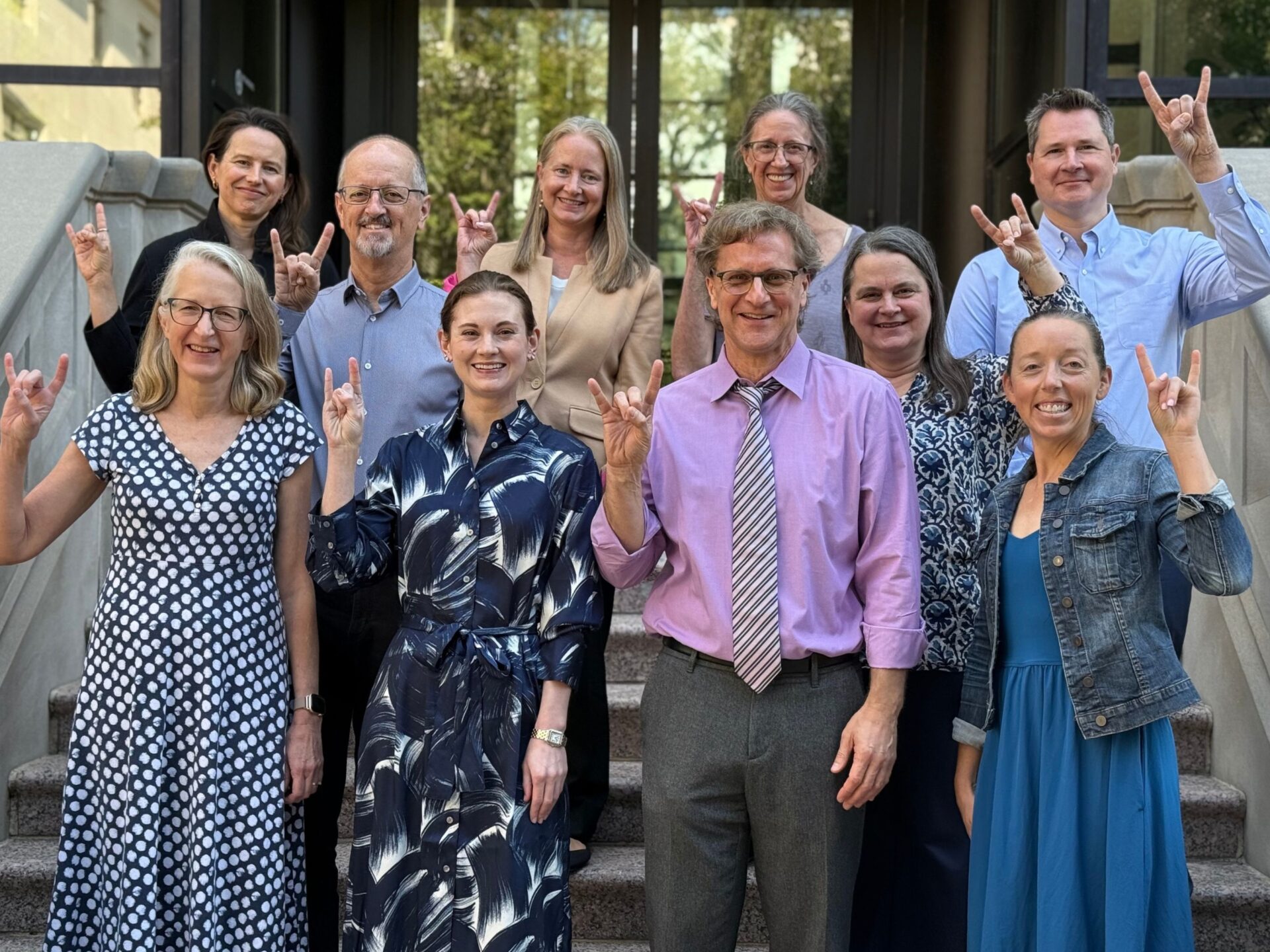
The program employs nine full-time faculty members with law degrees from top schools. Personally drawn to the writing component of practicing law, each instructs around 40 students, with support from a group of handpicked upper-level students known as “TQs” (for teaching quizmasters) who act as teaching assistants. Every Texas Law 1L takes a pair of core classes: Legal Analysis and Communication in the fall and Persuasive Writing and Advocacy in the spring.
In the fall, students learn memo writing, which involves reading court opinions, determining how the law applies to specific facts, and providing advice to clients. Rather than arguing for an outcome, “you’re predicting what the court will do,” says Kayla Oliver, who joined the legal writing faculty full time in August 2024.
Fall semester assignments don’t have a clear-cut answer. “That’s how it is in the real world,” says Wayne Schiess, who’s been on the legal writing faculty since 1992 and is retiring at the end of the 2026 school year. “You dig up the authorities and give your best objective analysis of why you think the result will come out a certain way.”
To get there, students learn an approach for analyzing a single legal issue or topic: CREACC—short for conclusion, rule, explanation, analysis, counter-analysis, and conclusion (yes, there are repeated conclusions).
CREACC ensures that future lawyers meet expectations, Robbi explains. “If you’ve been asked to write a memo, you need to deliver what your reader is expecting to see,” she says. (Robbi herself learned how to write a memo from the “amazing” Schiess, she adds. Prior to law school, Robbi earned a bachelor’s degree in English before editing Harlequin romance novels for the publishing company in New York City and later freelance writing jacket copy for its books.)
CREACC taught me how to organize my analysis logically, which made my writing much clearer and more persuasive.
Luca Azzariti Crousillat ’25
Alumni of the program regularly apply those lessons. “CREACC taught me how to organize my analysis logically, which made my writing much clearer and more persuasive,” says Luca Azzariti Crousillat ’25, an associate with Cokinos Young in New York City, who as a Texas Law 3L won the Paper Chase Legal Writing Competition. (Recently, Texas Law students swept the competition’s top three spots, the first time all the winners have come from a single law school.)
CREACC also proves helpful even before graduates start their careers. “Structuring my thoughts this way was particularly useful while preparing for the bar exam,” Azzariti says.
Persuasive Writing, Jazz Playing
During Texas Law’s spring semester, 1Ls learn to write an appellate brief—prepared for submission to an appeals court—and make an oral argument. Both involve persuasive writing and advocacy to encourage a particular outcome. Without relying on CREACC, students have more room for creativity. “Like jazz music, no two briefs are the same,” says Brandon Charnov ’25, a TQ alum.
Students are also prepared to compete in the Thad T. Hutcheson First-Year Moot Court competition, a tournament for Texas Law 1Ls.
Writing and oral argument ‘go together.’
Kayla Oliver, lecturer
Writing and oral argument “go together,” says Oliver, a Yale Law School grad who clerked on the Southern District of Texas and the 5th Circuit Court of Appeals, then taught an advanced appellate-writing course as an adjunct. She also practiced civil appellate law at Alexander Dubose & Jefferson LLP in Austin, where she remains of counsel.
To learn to combine the two, after drafting their briefs, students then practice oral arguments before “appellate judges” played by the program’s faculty. “You submitted your brief. Now you need to show up in court, present it, and answer our questions,” Schiess says of the exercise.
Learning New Skills
Beyond the fundamentals—“careful reading, analytical thinking, and precise use of words,” Bridges says—Texas Law students also learn more. For example, having a different professor each semester means 1Ls must adjust their written product to meet a professor’s personal tastes. “That’s how it is in practice,” Robbi says, where “you’re working with multiple partners, who may have very different writing styles or preferences. The best way a new attorney can add value is by figuring out how a person wants you to write and then writing in that style for them.”

The best way a new attorney can add value is by figuring out how a person wants you to write and then writing in that style for them.
Nelia Robbi ’07
In typical doctrinal courses, students are taught to determine whether a client has a legal remedy or obligation, says Mike Golden ’01, director of the school’s Advocacy Program. But Texas Law’s legal writing students learn “how to express what they’ve found in that analysis,” Golden says. When stepping into a courtroom, you can’t simply know the law and evidence supporting your claim. “You also have to be able to explain to the jury or judges why your client’s claim should prevail,” he says.
So legal writing directly enhances competition in moot courts where Advocacy Program students must draft their explanations, explains Golden. But even for mock trial competitions, which only require oral advocacy, “the ability to organize thoughts and express them,” honed in legal writing classes, “is the most critical element of success,” Golden says.
Throughout the program, faculty provide detailed notes on each writing assignment. “We learned to accept and incorporate feedback, manage deadlines, and communicate effectively with different audiences,” says Azzariti of skills that “are fundamental in a legal career—or any career—where the ability to adjust your approach and work well with others is as important as technical expertise.”
Those abilities get noticed. “Legal employers tell us that they’re confident when hiring Texas Law students,” Bridges says. “Employers know our students have the skills to be productive and reliable from day one.”
A Program Evolves

Texas Law’s legal writing program has evolved over several decades. In the legal profession historically, practical writing and research skills were taught informally or on the job. At the Law School in the 1970s, the legal research program headed by law librarian Roy Mersky began to formalize, introducing structured legal research instruction. Classes were initially led by TQs before English doctoral graduates were hired to teach writing. By the mid-1980s, juris doctor-holding faculty provided more relevant, practice-oriented instruction. Around that time, former faculty member Ed Sherman emphasized “that legal writing instruction should be delivered to our students by full-time, credentialed professionals,” Schiess explained in an article on Sherman at the time of his death in 2022. TQs continued to support those faculty.
Schiess has seen and implemented further changes over recent decades. Legal writing at Texas Law has steadily grown more rigorous and student-centered: increasing credit hours, shifting from pass/fail to graded assessments, and dramatically lowering class sizes. Today, there’s an emphasis on both analytical precision and persuasive advocacy—core skills for any practicing attorney.
The role for TQs, meanwhile, also changed. At one time, TQs had a social function (like the current Society Program student mentors) while working in the program. “The legal writing classes back then were huge. Four instructors taught all the sections” each made up of more than 110 students, recalls Bridges, who was a TQ in the 1990s. So, faculty meetings with individual students were impossible. That meant “the TQs had a much more central role” interacting one-on-one with students, she says.
Bridges has witnessed the many changes firsthand. She earned undergraduate degrees from The University of Texas at Austin, graduated from the Law School, and spent nine years in private practice. Then one day, “I saw an ad for this position in the Texas Lawyer newspaper,” she says. It looked interesting, so Bridges applied on a whim. “I thought, ‘Am I serious about giving up a law firm partnership to do this?’ But I knew that I would like it, and that’s been the case” for more than two decades, she says.
Top Faculty, TQs
Now TQs exclusively support fellow students’ legal writing coursework. They’re well prepared: TQs have previously earned high grades in their own legal writing classes and frequently also hold positions on the Texas Law Review. (Schiess notes that when he’s deciding which former students to hire as TQs, he can recall having some of the “fantastic” applicants in his classes, which helps with his decisions.)
Legal writing students are set for early-career success, due to “a realistic glimpse of the type of work they’ll likely do as summer associates and eventually as young lawyers,” says Charnov, who was a TQ for two years, including as the senior TQ in charge of helping with the final memo and final brief problem. He’s now a judicial law clerk for the Supreme Court of Texas in Austin.
For Charnov, being a TQ was “one of the most fulfilling experiences” in law school.
That’s because the role enabled him “to have a positive influence on so many 1Ls,” he says, (recalling how as a “nervous” 1L going into his first class, his own 2L and 3L friends provided direction). “Every day I was helping to make someone’s 1L experience a little bit better,” Charnov says.
Additionally, TQs “build a lifelong relationship with the professor they work for,” says Charnov. His TQ years were spent supporting Lori Mason ’94, who was also Charnov’s first semester legal writing professor. Mason taught him valuable lessons. “She has become one of my most trusted mentors and is someone I know will be there to support me throughout my legal career,” Charnov says. “The strong relationship that a TQ can develop with their professor is unique to the TQ program and one that I will always be grateful for.”
Legal writing students, too, can build strong relationships, thanks to the program’s comparatively small class sizes. “Those smaller group settings allowed me to get to know my classmates and professors,” says Kara Blomquist ’19, now an immigration staff attorney with Texas RioGrande Legal Aid in Edinburg, Texas.
Those smaller group settings allowed me to get to know my classmates and professors.
Kara Blomquist ’19
1Ls can’t participate in clinics, “so, pro bono programs and our smaller 1L classes were some of the first places I started to feel that sense of community,” she adds.
Talented TQs and exceptionally credentialed faculty—including alumni Mason and Ed Dawson ’01—make the program one of the nation’s strongest. The legal writing faculty “spend more time on critiquing and providing feedback than on any other part” of their job, Oliver says.
In addition, faculty meet regularly with individual students. “All of us are invested in the students’ success,” says Bridges. “We want to help them get better.”
“Watching students go from not knowing what a court of appeals is to crafting a detailed argument relying on a hierarchy of authority in three months is incredible,” says Oliver. “I love their energy and helping them figure out what’s important on their path.”
Schiess is self-deprecating but others acknowledge he’s a franchise player, both for the school and the legal writing community more broadly. He graduated from Cornell Law School and then practiced law for three years at the Texas firm of Baker Botts. He’s written numerous books and self-described “skills-related” articles on legal writing. Schiess has remained involved in the national legal writing community, primarily through the nonprofit Legal Writing Institute, where he was on the board of directors for four years. “Our legal writing program is as—or more—robust than almost any other in the U.S.,” Schiess says, pointing to colleagues who have law degrees from Harvard, Yale, Stanford, Cornell, and UT, as well as multiple faculty who completed federal clerkships or held editorial roles on the school’s law review.
Those are impressive credentials for any academic job, “but for legal writing, they’re particularly strong,” Schiess says.

Our legal writing program is as—or more—robust than almost any other in the U.S.
Wayne Schiess
Lifetime Abilities
Program alumni are equipped with an education for both their work and lives. Azzariti, for example, says he “learned how to approach legal writing with a focus on organization and clarity.”
“Those skills stayed with me throughout law school and into practice,” notes Azzariti, who says he often receives positive feedback on both the thoroughness and conciseness of his memos and briefs. In a fast-paced work environment, “partners and associates rely on being able to understand the law quickly and without any extra steps.” He also gained a disciplined approach to problem-solving.
Blomquist continues to “use both the traditional framework for organizing legal writing and the legal research skills” she learned as a 1L, and especially “identifying and applying legal rules have been vital throughout my legal career so far.”
Along with research, she also makes use of Boolean search abilities first developed in the program and refined through its hypothetical prompts. “Now, when my work has very real consequences, I can be more confident that my research is thorough and that I’m providing accurate legal advice,” Blomquist says.
Brady Lambeth ’19, an associate with A&O Shearman in Houston, has taken essential lessons from those classes: clear, efficient writing is often the most persuasive; first drafts don’t need to be perfect, getting started is key; and anticipating the reader’s questions strengthens the message (“This lesson has shaped not only how I write, but how I think,” he says.) The program also raised his “standards for clarity and precision. Legal writing taught me that grammar—used properly—can be an extremely effective writing tool,” Lambeth says.
The habits I built in 1L legal writing continue to shape how I communicate as a lawyer—and as a friend, husband, son, and brother.
Brady Lambeth ’19

Its classes encouraged him “to expect more from my own writing and to hold it to a higher standard,” he says.
He applies these skills daily as a transactional attorney. “Whether drafting contracts, reviewing edits, or handling emails, I rely on clear and intentional writing,” Lambeth says. “The habits I built in 1L legal writing continue to shape how I communicate as a lawyer—and as a friend, husband, son, and brother.”