
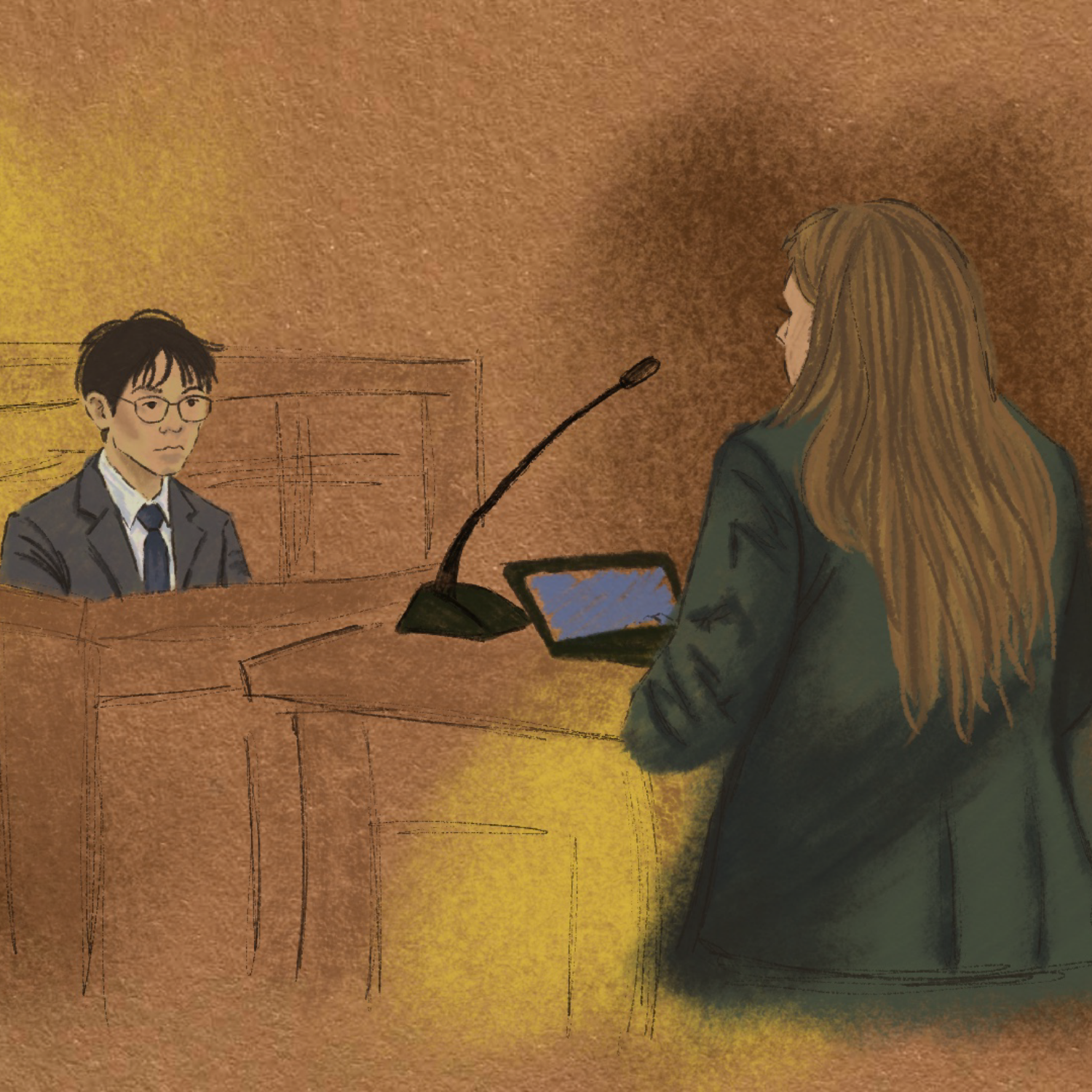
As Holly Gray ’26 walked into the courtroom on April 7, she glanced side to side at the spectators, then looked ahead at the bench. She had spent weeks preparing for this trial. She thought to herself, “This is showtime.”
It was indeed a show. Gray was one of 10 third-year Texas Law students examining expert witnesses in a mock murder trial in the school’s Eidman Courtroom. Unlike most mock trials, these witnesses were not actors portraying experts. They were third-year psychiatric residents and first-year child and adolescent psychiatry fellows from Dell Medical School testifying about psychiatric matters.
The trial was part of a collaboration, now in its 10th year, between UT Austin’s law and medical schools, recreating expert witness testimony at a jury trial. Law students get practice questioning witnesses, while psychiatrists get practice being witnesses.
“The more closely we can approximate the experience of doing this for real, the better learning experience it is for our students,” says Mike Golden ’01, director of Texas Law’s Advocacy Program, which prepares students to be litigators.
“Our whole goal is that anybody who wants to come to our program and put in the time can find themselves day one ready when they graduate. We have students who graduate and go to places like district attorney’s offices, where they are trying jury trials weeks after they pass the bar exam.”
Says Cortez Walters ’26, “These are skills you usually have to learn once you’re a lawyer. Not many schools provide the opportunity to learn them.”
Walters had already competed in five interscholastic mock trial competitions, but he found this event far more realistic. “It’s the first time I’ve done one with somebody who’s a real expert,” he says.
Collaboration for Education
The collaboration has deep roots in both schools. Texas Law’s Advocacy Program stretches back to the 1970s, when teaching courtroom skills in law school was first coming into vogue. So says Tracy McCormack ’86, Golden’s predecessor and now a senior lecturer, who directed the program from 2000 to 2022.
From its first years, she says, the program used trial settings. It started with moot courts, in which students practiced arguing before appeals panels. Mock jury trial competitions followed.
McCormack incorporated cross-campus collaborations to heighten authenticity. Students worked with licensed court reporters. They took on MBA students as mock clients and got coached on improvisation by drama students.
“These other disciplines have so much that they can offer us and that we can offer them,” she says. “We need to be collaborating with them.”
These other disciplines have so much that they can offer us and that we can offer them.
Tracy McCormack ’86
Joining Classes
In 2016, McCormack heard about another mock trial: for psychiatric residents at Seton Shoal Creek Hospital (now Ascension Seton Shoal Creek). Some residents played witnesses, while others played lawyers, and faculty played judges.
“They were gaining some familiarity and comfort with being in court, in case they were to be subpoenaed,” recalls forensic psychiatrist Dr. Julie Alonso, who organized the trial.
After attending the event, McCormack approached Alonso with a proposal to join forces.
“Both of us were doing these separate universes, and we could collaborate in a way that’s beneficial to both of our sets of students,” McCormack says.
The following year, the trial moved to the law school, with law students taking the roles of lawyers and Ami Larson, administrative law judge for the State Office of Administrative Hearings, serving as judge. Alonso created a case file for a fictional malpractice case.
A year later, she brought the collaboration to Dell Medical, where she had become assistant professor in Psychiatry & Behavioral Sciences.
Since then, the partnership has expanded to taking depositions and prepping witnesses. “Each year, it’s gotten better and better,” says Alonso, who’s now affiliate faculty.
Says McCormack, “The learning is deep, because it’s not just about the actual direct examination. It’s about getting them to appreciate how complex it is to represent clients in the real world.
“The more you can start to learn from everybody, no matter what their base skill set is, the better lawyer you’re going to be across the board.”
From Depositions to Trial
This year’s collaboration began in February, with 12 students in the advocacy class Taking Depositions and Handling Expert Witnesses.
They were given a file adapted from a 2001 Texas case, in which a Houston mother, while suffering from post-partum psychosis, had drowned her five children in a bathtub. The file included police reports, psychiatric evaluations, and other medical records.
The experts’ testimony would hinge on psychiatric questions, such as the defendant’s mental state at the time of the murder.
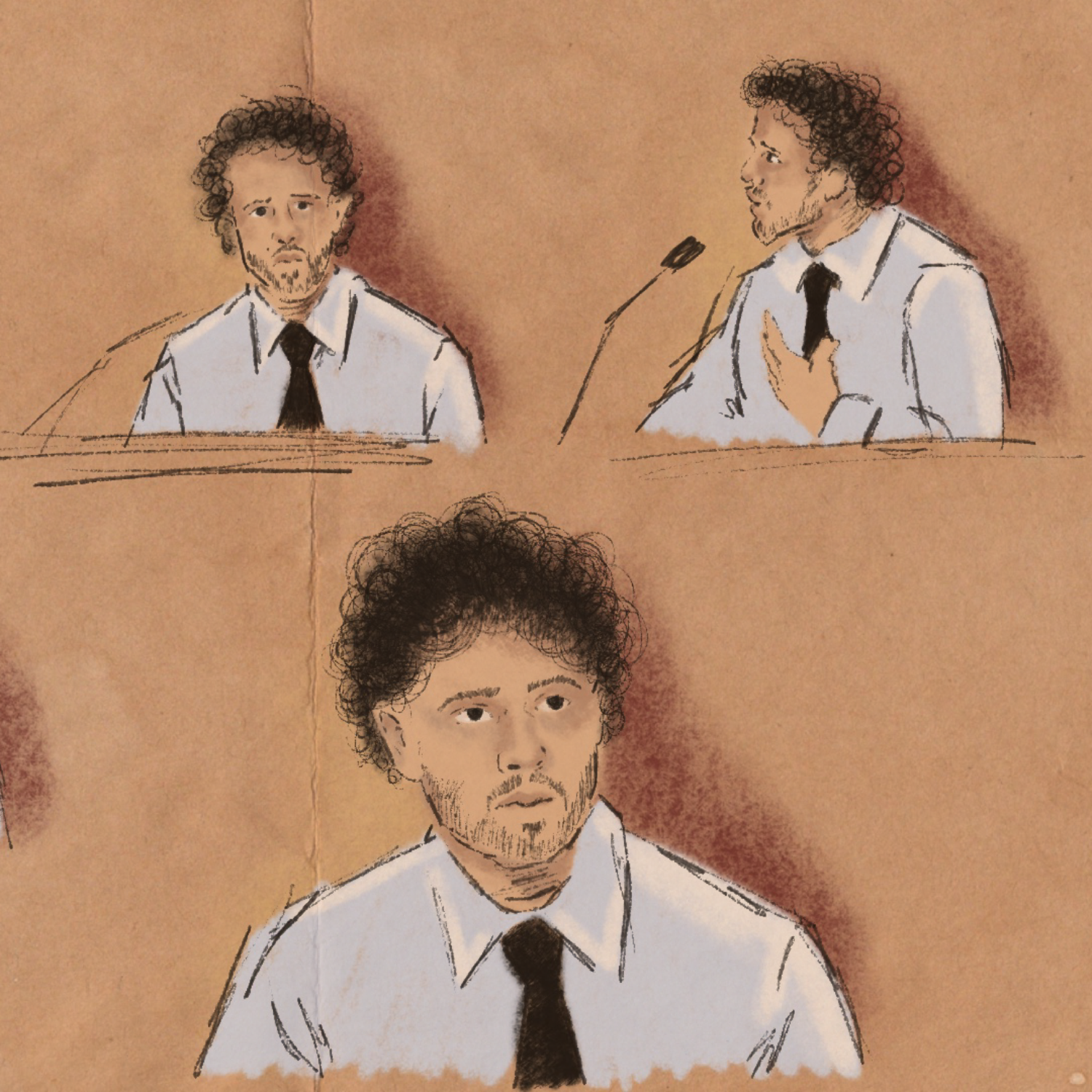
Eight medical school residents and fellows reviewed the file, divided equally between state and defense witnesses. Then, 16 law students took turns deposing them.
Gray and Walters both participated, on competing sides. “We prepped our expert on the types of questions that could be asked, what was the process, what were the rules,” Gray says. “Then we worked in teams to take depositions of the opposing side’s expert witnesses.”
One of the Dell Medical psychiatric residents, Hailey Barab, says, “The experience felt very realistic. I was asked to outline my credentials, explain why I qualified as an expert witness, and provide my psychiatric opinion on the case. A professional stenographer was hired to transcribe the entire deposition.”
Those depositions and the case file furnished the evidence for the mock trial. To involve as many people as possible, it included eight new residents and students from a different law class: Advanced Advocacy: Jury Selection & Psychology, taught by Golden.
To get ready for the trial, Golden says, “The last six weeks of the semester, we focus on the psychology of human communication and the psychology of juror persuasion. The program culminates every year with this partnership with the medical school.”
Order in the Court
At 1:05 p.m. on trial day, 30 residents from Dell Medical crowded the gallery. The space itself added to the drama, with a 30-foot ceiling, mahogany paneling, and green felt benches. It’s a room where the Texas Supreme Court has held oral arguments.
Judge Larson swore in the first expert witness, and the proceeding was off and running.
The format was to present four experts for the prosecution and four for the defense. To fit within a single class period — an hour and 50 minutes — lawyers had up to 10 minutes to examine their witnesses and up to eight minutes to cross-examine opposing ones.
Gray and Walters were both in the Advanced Advocacy class as well as the Depositions class, so both took part in the trial — again on opposing sides.
When her turn came, Gray presented a prosecution witness and examined her regarding two topics:
- Was the defendant in a state of mind to know right from wrong at the time of the murders — a required element for a guilty verdict?
- Did she understand the reading of her Miranda rights immediately after she was arrested?
Gray’s expert answered yes to both questions, listed the evidence she’d reviewed, and explained the key factors supporting her conclusions. She was then cross-examined by a defense attorney.
It was Walters’ turn. He conducted his examination methodically on why his expert had answered no to both questions, concluding that the defendant didn’t understand her actions were morally wrong.
Gray then aggressively cross-examined Walters’ witness, confronting him with statements in which the defendant had admitted she’d done something legally wrong.
Learning From Experience
The trial adjourned at 2:55, but many participants stuck around to get feedback from Judge Larson, Dr. Alonso and Prof. Golden. Much of it was for the witnesses, with advice such as keeping answers concise and not getting into arguments with opposing attorneys.
Walters gave himself feedback. He learned that examining a genuine expert was less predictable than examining an actor. “I had to adjust on the fly to rework, reorder, or skip questions based on what he said,” he says.
Gray enjoyed the cross-examination. “I felt very passionate,” she says. “I was able to lock the doctor into facing some bad facts that contradict his opinions.”
She felt, however, that she’d asked one question too many, giving the witness an opening to wiggle out of her rhetorical trap. “It’s always good to remember that sometimes less is more,” she says.
Both students say the mock trial has helped prepare them for real ones. After graduation, Gray will start in the Dallas office of Vinson & Elkins. She hopes to be assigned to a litigation group.
“I’m very excited about joining the workforce and being able to apply everything we’ve learned,” she says.
After graduation, Walters will be clerking for a federal judge at the U.S. District Court for the Western District of Louisiana in Alexandria. His long-term goal is to try criminal and civil rights cases, especially those involving excessive use of force by police.
We strive to make accurate real-world simulations…. This program with Dell Med takes it to the next level.
Mike Golden ’01, director of the Trial Advocacy Program
“My favorite aspect of being at Texas Law has been the advocacy program,” Walters says. “The classes and being on mock trial teams have been my favorite experiences.”
Those are the kinds of results that Golden hopes for. Coming just a few weeks before graduation, the joint venture with Dell Medical adds a finishing touch to his classroom teaching.
Barab, too, feels better able to serve as an expert witness. “Through this experience, I became more familiar with courtroom procedures and practiced communicating psychiatric concepts clearly and effectively in a legal setting,” she says.
“Our job is to prepare the students to be good at this in real life,” he says, “We strive to make accurate real-world simulations, so that when they get out there, they’re not doing these things for the first time. This program with Dell Med takes it to the next level.”