
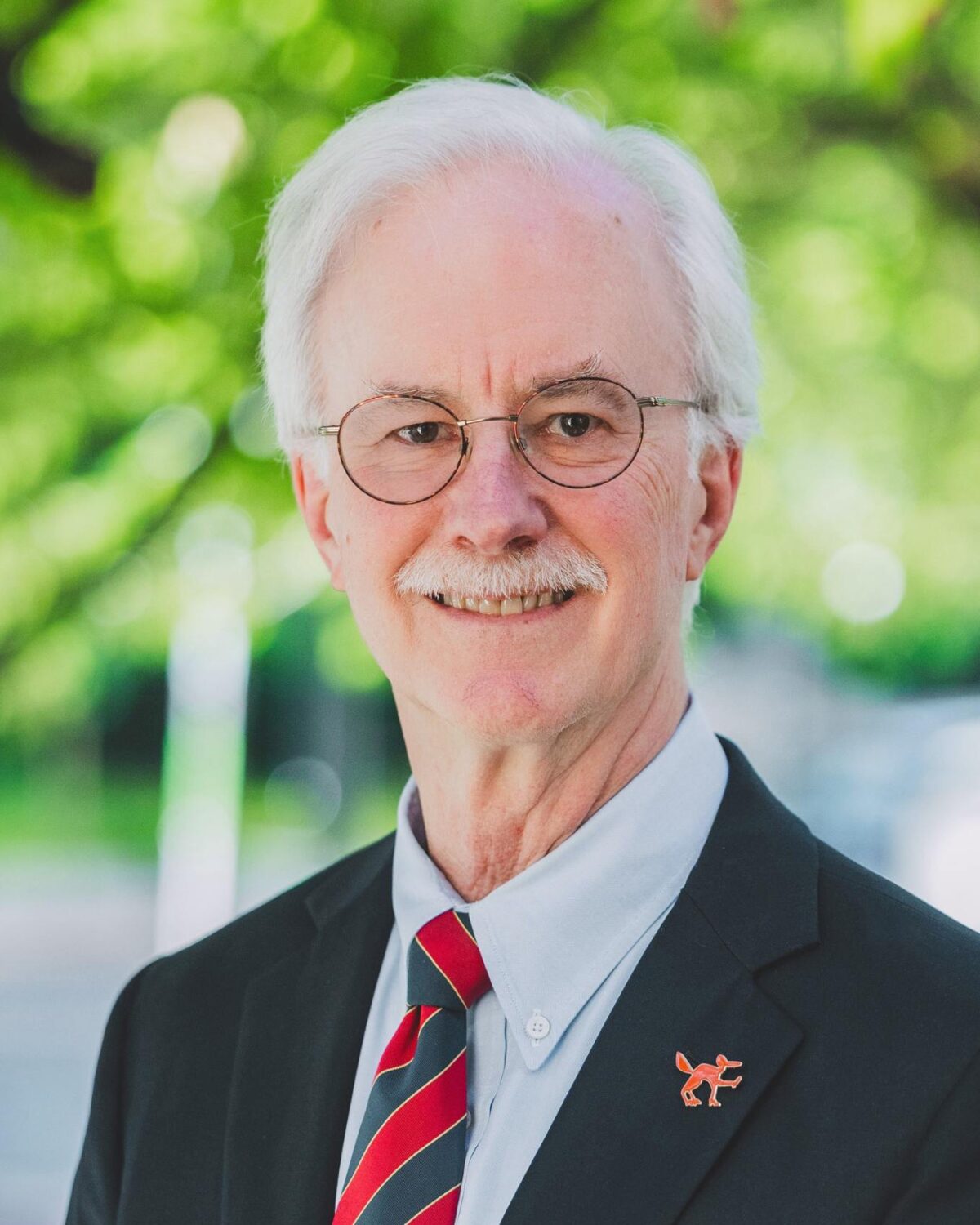
For more than four decades, George Slover has been a champion for small businesses and consumers, working to ensure they can compete and thrive—first by helping to write the rules as a congressional staffer, then by enforcing them at the Justice Department, and now by fighting to defend them as a consumer advocate.
The Dallas native, whose father and grandfather were attorneys, began his legal career clerking for Judge Robert Parker of the U.S. District Court for the Eastern District of Texas before moving to Washington, D.C., where he’s been ever since. Slover worked as counsel to Texas Congressman John Bryant and then the House Energy and Commerce Committee. After that, he became lead antitrust counsel for the House Judiciary Committee, helping to decide what should count as fair competition and what shouldn’t.
In his 11 years as an attorney-advisor in the Justice Department’s Antitrust Division, Slover helped enforce those rules, and explain and defend them before Congress, before returning to the House Judiciary Committee as chief legislative counsel and parliamentarian. He next joined Consumer Reports as Senior Policy Counsel, where he testified before Congress on several occasions on antitrust and other consumer protection issues.
Now, as General Counsel and Senior Counsel for Competition Policy at the Washington, D.C.-based Center for Democracy and Technology (CDT) since 2022, Slover has become one of the go-to voices explaining why a pricing algorithm can do the same damage as old-fashioned collusion between competitors, and deserves the same legal treatment.
He continues to testify before lawmakers, recently in Massachusetts about algorithm-driven rent-setting, and in Pennsylvania and Maryland about “surveillance pricing,” when companies mine a customer’s personal data to figure out by how much they’re willing to overpay. Slover calls the practice “bespoke pricing.” He is this year’s Distinguished Alumnus for Community Service honoree. We recently caught up with him.
Looking back on your time at Texas Law, what professors and experiences had the biggest impact on you?
I had a large number of very memorable and impactful experiences that have stayed with me. I’ll mention two. My torts professor, David Robertson, rode a motorcycle and played guitar. We read a case involving a spring gun—a booby trap used to protect a home by shooting an intruder—but it shot a friend opening the door, and the professor had written a song about it, which he performed in class. My property professor, Stanley Johansen, sang a song in the law school talent show, Assault and Flattery, that he’d written, a takeoff on the song from the musical Camelot, “If Ever I Should Leave You.” His specialty was wills and estates, so his song was “Whatever I Should Leave You.” Those were two memorable examples of how the law could be fun, and how law professors could illuminate their area of law with a dash of humor.
On top of those fun memories, law school really helped set the basis for me to write persuasively and pay attention to detail. Seeing how the law could be used to help make society better and improve people’s situations and keep them from being mistreated was a powerful lesson, too.
I also was at the LBJ School, getting a joint degree in law and public affairs. It helped expand my perspective about what could be done with a law degree beyond going to practice law in a law firm. While at the LBJ School, I took small-size seminars from Barbara Jordan and from Dagmar Hamilton, wife of Law Professor Bob Hamilton.
Your clerkship helped set the stage for a career that’s centered on protecting people, including consumers. How did the experience impact you?
I worked with Judge Parker—he was a great guy, very personable, very smart, and he had excellent judgment. There were a lot of personal injury cases, many involving workers who had been exposed to asbestos and had contracted asbestosis or mesothelioma, a cancer that is almost always fatal. It was about trying to get some relief for them or their families. The first case I worked on was a school desegregation case going back to the Nixon administration that was handed off to Judge Parker just as I arrived. The case was very controversial. As part of the court-ordered remedy, the two high schools, one almost all Black and one almost all white, were merged into one. The Black high school had a powerhouse football team that had produced NFL players, and the coach of that team became the coach for the merged team. The following year, they won the state championship, which helped settle things down in the community.
Once the clerkship ended, how did you make the transition to working in government in Washington D.C.?
A friend I’d made my first semester in law school had worked in Washington, D.C. for a Texas Congressman. He described how much he’d enjoyed that job, and it got me thinking I might do that myself. So after the clerkship, I moved to Washington to see if I could get a job for a Texas Congressman, like my friend had done, thinking it would be for a couple of interesting years before I returned to Texas. I got hired by Dallas-area Congressman John Bryant, and among the things I worked on for him was the major immigration reform law enacted in 1986, which paired tougher enforcement with relief for people living in the country, helping secure funding to reimburse states like Texas for immigrant services, strengthening protections against discrimination targeting Hispanic citizens and legal residents, and closing a loophole that had let employers exploit undocumented workers. I also helped the Congressman stop a bill that would have seriously weakened product liability law protections for consumers and workers, including in Texas.
Several governmental positions later, you ended up back on the House Judiciary Committee, this time as chief legislative counsel and parliamentarian. What was that role like?
I looked at most of the written product before it went out, including the chairman’s statements, committee reports, bills. I wasn’t the final decision maker, but had a hand in helping review and shape them. The parliamentarian’s role is to keep things running smoothly and make sure the rules are followed meticulously, because if they’re not, the minority party can object, raise a point of order, or slow things down. I also continued working on antitrust, as I had in my jobs over the previous two decades.
My next job was at the advocacy division of Consumer Reports. I continued to work on antitrust and competition there, but also on other consumer protection issues, including telecommunications, product and food safety, and privacy. My work involved engaging with the government essentially as a lobbyist on behalf of consumers. After 30 years in government, it felt like a natural segue.
Looking back on your career, can you tell us about an advocacy project you’re especially proud of—perhaps one that flew under the radar, but ended up making a meaningful, lasting difference?
At Consumer Reports, I fought to protect something that might sound small, but wasn’t: the right to unlock your own cell phone and switch carriers, so you didn’t have to throw it in the trash and start over. A copyright law meant to stop digital piracy had an unintended side effect, letting carriers treat unlocking as illegal—and when a regulatory exception protecting consumers lapsed and was being abandoned, I testified before Congress to get it restored. That fight helped plant the seeds of the broader “right to repair” movement, and I later helped draft model legislation that’s since become the basis for right-to-repair laws in states across the country.
Over the course of your career, how have the consumer protection issues you’ve worked on evolved?
The traditional focus is having a market that’s open to competitors so there are choices for consumers. But in the digital world, one of the things that’s beneficial to a company is the data it has on its customers. If that data is shared too broadly, it can be misused. Surveillance pricing, or bespoke pricing, is tailored to a particular customer based on the profile a seller has created for them. What’s being customized is the price, and the concern is when people pay more simply because they’ve been identified as willing or able to do so. The technology is available, and the temptation to use it is going to be irresistible. So, we’re seeking to have Congress and state legislators get a handle on it before it spreads and becomes the de facto way people have to buy things. Throughout my career, I’ve enjoyed focusing on people and their interests and needs, and trying to make sure the law protects them appropriately, without overreach.
What’s bringing you joy outside of work these days?
It’s fun to keep track of what my kids are up to. My son Grayson is at Texas Law, midway through the joint program with the LBJ School. My daughter, Rachel, lives in Manhattan Beach, a suburb of Los Angeles, and is working in data analytics at the nonprofit think tank and research organization RAND. Also, for 40 years, I’d been thinking about getting the Stetson Open Road hat, and I finally did. It’s sometimes called “the LBJ hat” because LBJ famously wore it. I got to the age where I didn’t care if somebody thought I was a little eccentric wearing what looks like a cowboy hat in Washington, D.C. I wear mine when I’m out walking the dog and also to work.