
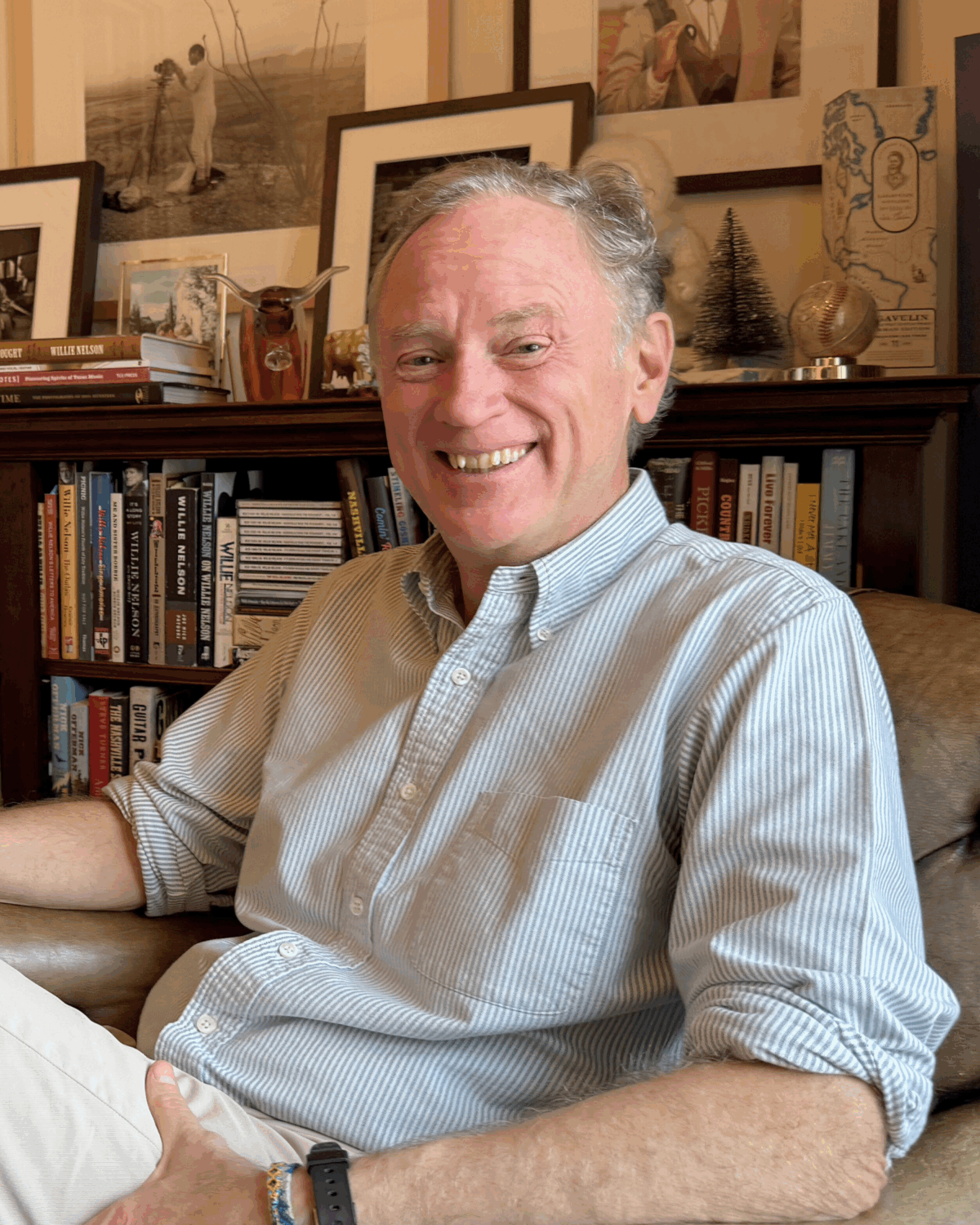
John Spong ’93 hosts the PRX music history podcast “One by Willie,” in which he talks to prominent Willie Nelson fans about the songs that mean most to them. He and PRX create the show in partnership with Texas Monthly, where Spong wrote about popular culture from 1997 to 2024.
Spong has been nominated for three National Magazine Awards, including in 2021 as coeditor and lead writer on two large projects: “Willie: Now, More than Ever,” a finalist for best single-topic issue; and “All 146 Willie Nelson Albums, Ranked,” nominated for best digital storytelling. Spong has twice won the nonprofit Texas Institute of Letters’ O. Henry Award for magazine journalism. He’s the author of “A Book on the Making of Lonesome Dove.”
He’s also a double Longhorn, with an undergraduate degree from The University of Texas at Austin in history with a minor in English, as well as a juris doctor from Texas Law.
Recently, we visited Spong’s Austin home to hear about his path from law school to magazine writing; the connections between Texas Monthly and Texas Law; the origin of the “One by Willie” podcast, which has a new season launching in March; and the song that takes Spong back to when he lived in a tool shed during law school.
What originally drew you to law school?
Growing up in Austin, my teachers said, “You should be a lawyer.” I really liked to write. In undergrad, I took a writing component course where the first assignment was about the role writing would play in your chosen profession. I talked to a friend whose dad was a lawyer. He said, “Writing is all you do as a lawyer.” My paper’s opening was about how if the TV show “L.A. Law” was closer to the truth, it would show them sitting at a keyboard going to town. The professor read my paper aloud to the class, which was cool.
Also, I wasn’t sure what I wanted to do after college, and law school seemed like a great place to spend three years and be wide open for whatever I did want to do when I got out. Law school was a lot cheaper then: Student loans of $21,000 paid for three years.
Do you have any favorite law professors? Or others who stood out?
Lynn Blais, Sam Issacharoff, and Jack Balkin. I went to a summer school in Cambridge, England, with a bunch of kids from Valparaiso Law School in Indiana, who were all floored by the fact that I’d had Bob Hamilton for Contracts, because he wrote their textbook. Charles Alan Wright had a Supreme Court seminar where nine kids got in, and each one was assigned the role of a sitting Supreme Court justice. Professor Wright would give us files that were pending in front of the court at that moment. We would read past writings and opinions by our justices; come up with how they would vote; and write an opinion, concurrence, or whatever in their voices. It was so outside the box and so much more involved than anything I had done in undergrad. I loved every bit of it.
After taking the bar exam, you interned at Texas Monthly rather than finding a law job. How did you land that internship?
I’d grown up wanting to write magazine stories, badly enough that I didn’t try too hard to get an attorney job that summer of the bar. I applied only at the small Austin firm where I’d clerked through law school, and they weren’t hiring. But back in high school, I’d become friends with Joe Nick Patoski. He was a Rolling Stone stringer in Austin in the ’70s, and the primary culture writer for Texas Monthly in the late ’80s and beyond. He liked the idea of making me his personal intern and brought me on. Became a great mentor.
The timing was wonderful. I started for Joe Nick on Labor Day, 1993. That day, the firm called and offered me a job. I told them I’d take it but couldn’t start until the internship ended at the turn of the year, prompting the name partner to ask, “What are they paying you?” When I replied, “It’s unpaid,” he just shook his head.
My first big assignment as an intern was to interview Willie on his bus that October. That pretty much sealed the deal for me.
So, what happened when you finished the internship at Texas Monthly and started work as an attorney?
I worked for a small litigation firm in Austin. The name partner didn’t want us working 70 hours a week. He gave me a lot of responsibility early. Within a year of getting there, we had a huge case in the courtroom. The clients were largely in the right. All the things that would normally be barriers to enjoying a legal career were controlled for. And I still didn’t like it. Every day, I was going home for lunch, taking a nap for an hour, and then going back to the office and falling asleep at my desk in the afternoon. Jack Ratliff in his Texas Civil Procedure class said, “Sleeping too much is a sign of depression.” So, I was like, “Maybe this isn’t for me.”
Being a lawyer wasn’t lighting me up, although there are a bunch of ways to be a lawyer that are very rewarding to the soul. All my friends were musicians and songwriters who went on to have real success, but at the time were doing it because they felt they had to do.
While I was at Texas Monthly, I discovered the New Yorker and started subscribing. When I became an attorney, it showed up in the mailbox every Monday. I lived across from Shady Grove restaurant in the little stone house above the juice bar. I would get home from work in my suit—even in the summer, when it was 100 degrees—pick up the New Yorker, and scan the table of contents on the walk up. And almost every Monday, I’d end up stopping on the stairs and reading until it got dark. No regard for the heat. I was like, “This does something to me that practicing law doesn’t. This is what I need to at least attempt.”
There are a bunch of ways to be a lawyer that are very rewarding to the soul.
With that realization, how did you transition to magazine work?
My first job at Texas Monthly was as a fact checker. If you’ve got a law degree from UT and a bar card, your resume is going to stand out in the stack of applicants for a fact-checking job. They didn’t even talk to anybody else. Through fact-checking and deconstructing other writers’ stories—Skip Hollandsworth’s in particular, he’s a brilliant reporter—I learned journalism. Skip did true crime stories, and there were some that we might get sued over. David Anderson—one of the big Con Law professors who’s got a journalism background, too—read every story before they went to press, and he had since the magazine started in ‘73. I would have long talks with Anderson about where we might get in trouble or not. All of that was this great way to accidentally get trained for what I wanted to do.
I had never taken a journalism course, but in law school I learned to look at an issue from every point of view—come at it from every direction. The reporting process in writing a magazine story is the discovery process in litigation. You work on a story for two or three months. If it’s a big case, you’ll work for months, maybe years even, and you’ll talk to 10, 20, 30 people, depending on how big the claim is. You’re crafting a narrative that in litigation you sell to a jury, and in magazines you’ve got to get readers interested. In litigation, though, the outcome of the story is determined by the person paying you. Also, there wasn’t room for creativity in the way there is with writing a magazine story. But it did feel like the same exercise.
The reporting process in writing a magazine story is the discovery process in litigation… You’re crafting a narrative that in litigation you sell to a jury, and in magazines you’ve got to get readers interested.
Early on, you did some law-related writing at Texas Monthly.
I was given a legal column. The first assignment was writing about a hate crimes bill at the Texas Capitol during session. I thought there was a real difference between hate and other speech, or at least a different effect. The editor, Paul Burka ’67—who was brilliant and one of the reasons there even is a Texas Monthly, because he was so good at what he did for so long—wanted me to take the other side. He said that punishing hate speech is punishing speech is punishing thought, so you can’t do it. We went back and forth. I spent a bunch of time in the law library researching, as well as for other columns.
It wasn’t the kind of writing I wanted to be doing. I did a Dixie Chicks story, because they were in a big contract dispute, about hanging out with them. Music was much more what I was into, so it didn’t feel like a legal column. My story about being on jury duty was experiential reporting, and in line with the kind of things I wanted to be writing. I stopped doing the legal column, luckily didn’t get fired, and started doing that other kind of writing and it took off.
Texas Monthly has deep ties to Texas Law: you’ve mentioned Anderson and Burka. Mike Levy ’72, the magazine’s founder, also graduated from the Law School.
When I was in high school, I went to a lecture Burka gave at the Law School about how the state legislature works. He was so entertaining and smart. Watching that 45-minute talk, in one of the big lecture halls, lit fires—the little one for law school and the bigger one later for journalism. Burka was a complete slob—or maybe I should say, “less than tidy”—in the way he kept his workspace. Texas Monthly used to get a staffer to clean his office every nine months. Once, he found this note I had written 10 or 12 years earlier, after I’d gotten out of law, because I had a second internship for Burka. “Mr. Burka, my name is John Spong. I would like to apply for your spring internship at the legislature.” I don’t think he’d ever seen it. It was under a two-foot-tall stack of (stuff). I have no idea how I got the job. But all of that sprang from watching Paul’s lecture. He was so appreciative of the law school education and what it made possible for him. Anytime he was asked or had a chance, he would be there because law school was such an important experience for him.
Levy is an amazing dude. He wanted to make a city newspaper for all of Texas. It was a bad idea, but he pulled it off with great hires and force of personality. He’s very in-your-face. When I first met him at a Christmas party—as an intern and recent UT grad who was probably not supposed to be there—the friend who introduced me to Levy was his assistant at the time. She said, “This is John. He just graduated from law school.” He pulled out his bar card, stuck it in my face, and said, “I don’t practice, but I keep this active. Do the same.” My bar card is still active today because Levy told me to in that moment.
Paul died a few years ago, but I talk to Levy all the time.
You’ve written two stories on Joe Jamail ’53, including one where you attended his final trial, which took place in Beaumont. Do you recall any stories he shared?
We would sit in the bar at the Holiday Inn, where we stayed, and he would pound scotches and tell stories: He’s on the Cotton Bowl sidelines with Willie Nelson, they’re both hammered, there’s an interception, and somebody runs it back for a touchdown. And either Jamail jumped on Willie’s back or Willie jumped on Jamail’s back and they ran down the field trailing the defensive back. That can’t possibly have happened, but I have no reason to doubt it. It’s Jamail, completely larger than life. It was so much fun getting to know him and spend time with him like that where he’s telling stories.
Your podcast, “One by Willie”—where you interview notable people about their favorite songs by the Red Headed Stranger—launched in 2020. Why focus a podcast on him?
Willie’s cultural impact on the state was so great, so total, that it can be hard to fully appreciate from this vantage point. Like bringing the hippies and rednecks together. Steve Earle, who grew up in San Antonio, talked on “One by Willie” about how anytime he left the house in high school, he risked having a group of goat-roper kids pinning him down, cutting his hair, and stealing his boots. And then there’s all the sophistication Willie brought to bear in his music, not just in the jazz influence in his melodies and the way he sings, but in the deep emotional intelligence of his lyrics. I mean, Wynton Marsalis and Keith Richards are among his biggest fans. So Willie changed not just the way life is lived in Texas, but also the way the world sees us.
How did the idea for the podcast come about?
“Dolly Parton’s America” was a huge podcast. Texas Monthly was like, “Can we do a Willie podcast?” And I said, “Willie’s relationship with his fans is often about individual songs, so let’s do a podcast where notable people who love Willie talk about one song that means something to them and why.” So, we did eight of them with people who I knew that would answer our calls, like Lyle Lovett, Jack Ingram, and a few others. Margo Price, who I didn’t know, was the first one we did. She loves Willie so much that it didn’t matter that we had no track record, and she didn’t know me. The podcast kept building momentum because people would introduce us to other people. Nick Offerman’s publicist reached out saying, “Can Nick be on your show?” She gave me Whoopi Goldberg’s email address.
The podcast is everybody from Lyle Lovett listening to “Hello Walls” and talking about being a kid in rural Klein, Texas—a German farming community outside of Houston—in dance halls and sneaking beers from your grandparents, to Brené Brown talking about how Willie’s version of “Amazing Grace,” the first time she heard it, informed every single thing she’s taught in her career. Willie’s art and example have resonated with people and made their lives better. Their appreciation for that has made this a wonderful thing to work on.

On March 11, the podcast’s seventh season launches. What can listeners expect?
The first episode will be Kenny Chesney, who said through the ’90s he was successful, but nobody knew who he was. He was writing songs for the radio. Around 2001, Chesney decided to be true to himself, like Willie did when he moved to Austin. The next album was “No Shoes, No Shirt, No Problems.” The new season also has novelist George Saunders, blues great Taj Mahal, and Matt Berninger from the National. And Wynton Marsalis, Emmylou Harris, and Alison Krauss are supposed to do it.
We’re looking forward to it. Is there a Willie song you associate with your time at Texas Law?
A friend died tragically at the start of the second year of law school. Willie’s album “Across the Borderline” came out in ’93, my last of law school. His duet with Bonnie Raitt on that record, a beautiful song called “Getting Over You” was on the jukebox at the Deep Eddy Cabaret. People in law school were friends with this guy, too, and we were there a lot and listened to that song nonstop.
Hearing it takes me back to those years in law school, when I lived in a tool shed with no running water on Bee Caves Road. There was a house that had been turned into a golf course developer’s office, with a two-person staff, and in front was a portable shed with two rooms. Everybody in my class knew it as “the shack.” We had a graduation party there that Bruce and Charlie Robison played—the whole class came out—and it made for a very rough graduation morning at the Erwin Center. But a handful of those friends and I would be at Deep Eddy, and we would listen to “Getting Over You.” Last year, for Willie’s birthday, Bonnie Raitt agreed to do a birthday episode of the podcast and talk about that song. It was written by a dear friend of hers who died young, so we have this communal moment talking about it. Every time I hear it, I’m right back there, racing from the law library to Deep Eddy.
Thanks for sharing that. Given your work, do you have any advice for current students who are considering careers outside of the law?
Take the classes that are exciting to you, because any time you enjoy what you’re learning, you learn it better. If a class is reading the same thing you’d be reading for pleasure, then your life just improved by a measure that’s hard to quantify. And it’s like time in the batting cage: It makes it easier to learn the stuff that’s less interesting to you once you get there.
Take the classes that are exciting to you, because any time you enjoy what you’re learning, you learn it better… It’s like time in the batting cage: It makes it easier to learn the stuff that’s less interesting to you once you get there.
Great advice. Do you stay in touch with any classmates from law school?
A couple, and it’s great. Many of the people in my 1L study group aren’t practicing law anymore, which is probably why we were drawn together in the first place. My friend Burton Baldridge ’93, I remember watching him take notes in class our first year, and he had four different colored pens—for the evidence, context, arguments, and holding. I was thinking, “You might be an architect.” And now he’s one of the most important architects in Austin. He makes these immaculate glass homes, straight lines, could not be cleaner. They’re beautiful structures.
Thinking about your years at the Law School, does anything else that come to mind?
I could not be more grateful for that time. I’d never been around that many smart people at one time in one place. It was great to have professors throw ideas at me, challenging my attention to see which idea I would grab and explore. To leave law school thinking that that’s the way life should work is something I’m grateful for.
Additional reporting by Emily Eigenmann.