
Being a law firm summer associate felt “like drinking from a firehose after you just got done drinking from a firehose your entire first year” of law school, says second-year Texas Law student Lauren Swords.
Swords’s experience is hardly unique. With large law firms recruiting on campuses earlier than ever, many students are weighing career choices even as they’re still becoming acclimated to law school itself. As a result, top schools are looking for innovative ways to bring more practice knowledge to students alongside their first-year doctrinal courses.
At Texas Law, one important development along these lines is its early adoption of rubi, a legal tech platform that helps students and new attorneys get their bearings in transactional practice and addresses some of the challenges posed by adjusting to what can seem like an unfamiliar world.

rubi’s legal training modules have been a great complement to what we’re doing in the classroom and in our program.
Professor Eliot Cotton, director of the Law and Business Program
After access to rubi was piloted through the school’s Law and Business Program, the platform was launched schoolwide for the 2025-26 academic year, drawing the participation of more than 300 students. Now, Texas Law’s commitment to rubi’s is expanding. Starting with the 2026-27 year, all first-year law students have automatically been granted access to rubi’s virtual apprenticeship platform (while all 2L, 3L, and LL.M. students continue to enjoy that opportunity). In addition, students are receiving early access to rubi’s newest tool, an AI Mentor built on “the rubi approach,” providing fully customizable, real-time advice on a host of substantive and professional development questions students eyeing a career in transactional work might have.
“I love anything that we can do to make education interesting and fun,” says Professor Eliot Cotton ’10, director of the Law and Business Program. “Especially if it helps them walk out of here more prepared for their job on day one. And rubi’s legal training modules have been a great complement to what we’re doing in the classroom and in our program.”
Big Law Beginnings

The rubi founders and co-CEOs are two former Norton Rose Fulbright attorneys, Madison Keeble, who was a senior associate in the firm’s Dallas and Austin offices, and Geetika Jerath, a former associate in the Houston and Austin offices. They connected in 2019 when Jerath, new to Norton Rose Fulbright, came to Keeble for advice on navigating Big Law. The two first-generation lawyers went on to spend years leading deals and training new classes of associates together before stepping off the partnership track to build rubi.
They are also both UT Austin alumnae, which explains why they set their sights on launching their legal training tool with the university’s flagship law school.
“Texas Law is leading the way in preparing students to be lawyers,” say Keeble and Jerath. “And rubi is built on the belief that apprenticeship is still the best way to learn how to practice law. The skills lawyers build early shape everything that follows, so it’s amazing to help students get that experience before they even set foot in a firm.
“As proud Longhorns, having Texas Law as our first institutional partner is especially meaningful!”
“The Right Factory Settings”
Born of the Big Law experience of its founders, rubi provides self-paced modules that walk users through not only the entire transactional process but also what it’s like to be a first-year associate working on a deal. For example, the first assignment is to write an email to a partner in response to a staffing request that conflicts with a mandatory associate training. Facing that situation is rarely something you’ll learn in the first year of law school, but handling it well can make a big difference in how that partner perceives you.
Along the way, users work with templates for common tasks, such as closing checklists, along with explanations of the big picture that junior attorneys often don’t see. “Context is hugely important in professional practice,” says Keeble. “The modules build on the skills learned in a classroom setting and help layer on context and complexity, all through an end-to-end virtual apprenticeship simulating the experience traditionally gained through years of practice.”
For Swords, rubi gave her a leg up on her first day as a summer associate at Clifford Chance’s Houston office. “Even if you don’t know—which you don’t—the ins and outs of a transaction, or you’re not a substantive legal genius yet, you still can add value from the first day,” she says.
Even if you don’t know—which you don’t—the ins and outs of a transaction, or you’re not a substantive legal genius yet, you still can add value from the first day
Lauren Swords ’28
“You can take notes on everything, make sure you know when things are expected from you, send a redline, and always ask your supervisor what their preferences are,” adds Swords, who likes to say that rubi helped her “come in with the right factory settings.”
Alignment With Law and Business Program
In July 2024, when Jerath and Keeble were building rubi, Cotton was returning to Austin after a successful career as co-general counsel and managing director at Riverstone Holdings, a New York-based private equity firm, to become the inaugural director of the Law School’s new program for students interested in business matters. The program Cotton designed includes courses, extracurricular activities, and a community for law students interested in careers in transactional law. Cotton, a double Longhorn, had started his career in the New York office of Vinson & Elkins, where he represented clients in mergers and acquisitions and capital markets. He wanted to share his own experience with law students.
“Law school prepared me to have an amazing career in these areas,” says Cotton, “but I also felt there were things I learned from practice that could be hugely impactful for today’s students.
I love what LAB can do to give students specialized training and community. That’s why I was so excited by what Geetika and Madison have done with rubi.
Professor Eliot Cotton
“I love what LAB can do to give students specialized training and community. That’s why I was so excited by what Geetika and Madison have done with rubi.”
The self-paced modules, which include examples of how specific scenarios are addressed, help bring to life the lessons students are learning in their doctrinal classes. Unlike in continuing legal education, users are encouraged to complete the tasks to simulate the real experience of a transactional associate at a law firm. Further, the modules are interconnected and lead the user along the path to the completion of a deal. Users come away with practical skills that complement their substantive law courses and business-related electives.
Sydney Moore ’26 was a member of the inaugural class of the LAB Fellows scholarship program and was an early adopter of rubi’s pilot. This gave her an opportunity to provide input to Keeble and Jerath.
“It was overwhelmingly positive,” says Moore, who worked in business operations before law school. “I thought it was such a cool thing because, even for someone who had business experience, there’s so much legal jargon and just understanding the deal from the lawyer side that I just had no idea about.” Moore returned to rubi’s modules to help prepare herself for her first postgraduation job as a corporate law clerk at Vinson & Elkins.
For students like Swords and Moore, who are already set on transactional work, rubi gives a taste of practice experience. But the rubi platform can be uncommonly helpful for those undecided students who are figuring out if they want to practice business-related law.
Second-year student Cade Young also learned about rubi through the LAB Program. He appreciated that he could work through the self-paced modules during a break between the end of school and the start of his summer associate position with Vinson & Elkins. Young arrived at law school with an interest in business but wanted to explore different facets of practice. “When I came into law school, I had somewhat of an idea, but you’re learning a lot on the fly, and so any bit of information or exposure you can get is only going to help you in the long run, even if it’s just to help you cross something off your list,” he says.
An Industry in Transition
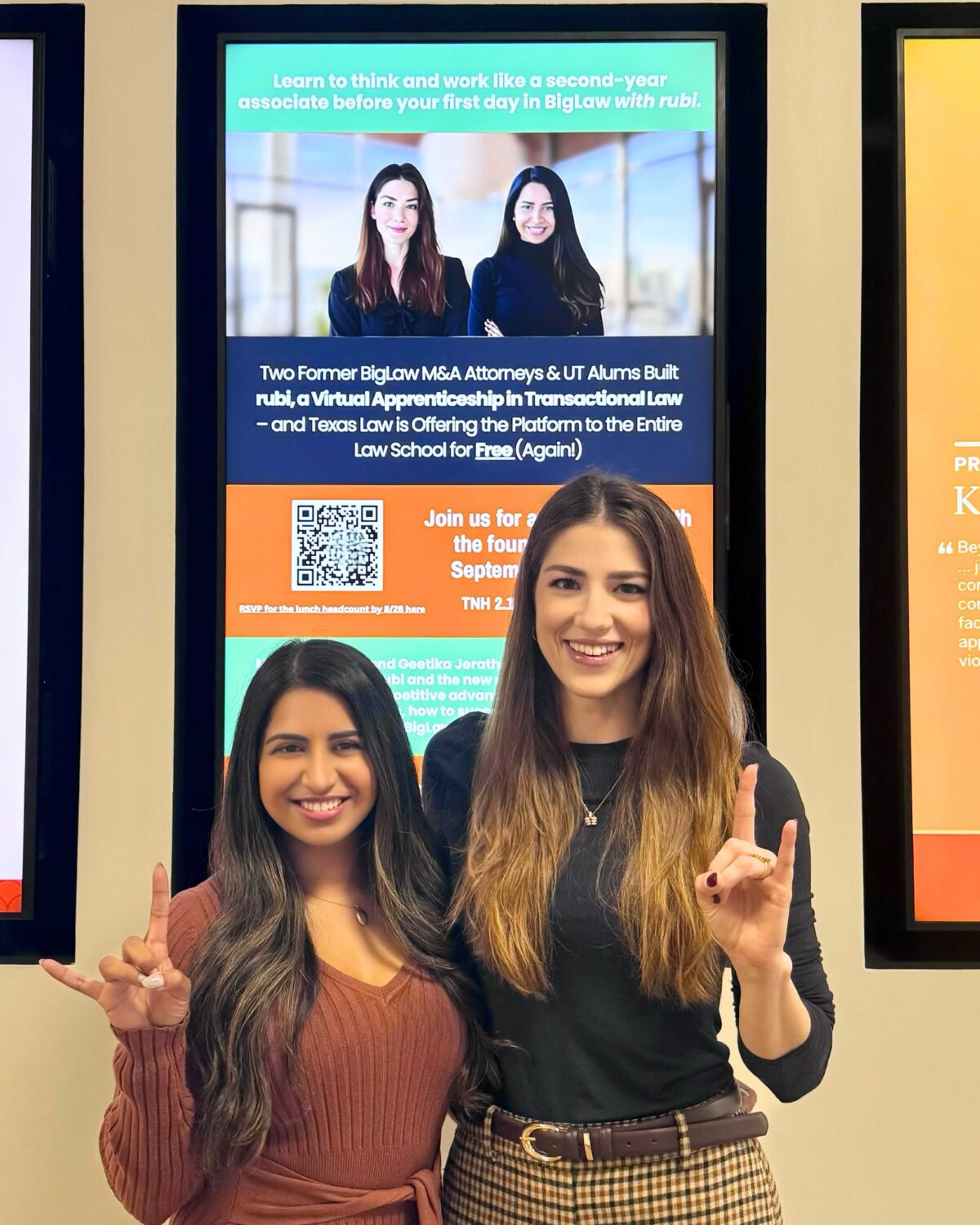
The founders’ experience as associates when pandemic shutdowns began means that they know firsthand what it’s like to be figuring out a career during a time of transition. They compare their experience with the current uncertainty about AI and the future of the practice.
“We relate to the juniors and the law students right now because we had gone through a very big shift in the industry, and then seeing it happen again, we get it,” remarks Jerath. “We wanted to build something that helped them just as much as we would have liked back when we were starting out.”
The new rubi AI Mentor was trained on three years’ worth of rubi’s approach and intellectual property and includes modes for mentorship, more intensive tutoring, and interview preparation. “Now we’re seeing students and attorneys go back in after they complete the program, and if something happens at work, they ask the mentor a question, and it’s just like if they had asked us the question,” says Keeble. In addition to launching the rubi AI Mentor at Texas Law, the company has announced a new institutional partnership with Pillsbury Winthrop Shaw Pittman LLP, making it the first Am Law 100 firm to adopt the rubi AI Mentor, and has expanded to other law firms and schools.
Prepared for Practice
Nyah Mathews ’26, now a first-year associate at Kirkland & Ellis, has been using the new AI tool to help her navigate the first few weeks of work. “Take a deep breath,” it told her before pointing her in the right direction. Like Moore, she reviewed rubi as a refresher before jumping into her career, and she values the practice it gives her in navigating law firm life and handling the types of assignments that associates need to handle quickly and responsibly.
Cotton thinks Texas Law’s collaboration with rubi is paying off. As firms continue to implement AI tools and the job market tightens, Cotton says his goal is to give students every available advantage in the classroom and with tools like rubi. “Throughout the course of the school year, I have students come up to me saying they were in an interview and they were able to talk about something that I either taught, they either heard about in one of my classes, or they learned through rubi,” he says.
“It’s the combination that seems particularly powerful.”
Swords credits rubi in part with the positive feedback she received in her end-of-summer review. The firm asked her to come back next summer and has already offered her a full-time position after graduation. “Lauren came to assignments well prepared and really demonstrated strong attention to detail,” says Clifford Chance partner Om Pandya. “She asked thoughtful questions and was substantively up to speed on the deals far more than I would expect from an incoming associate, both from a legal and business view. Lauren’s preparation and professionalism allowed her to add value from the outset and provide work product that was used on live deals.”
Young sees the benefits of rubi and the Law and Business Program as proof points of a larger story. “I’m really glad for both those programs, but also that Texas Law as a whole is leading the charge in being so willing and open to work with students from all different areas of interest, and to meet them where they’re at, and to really provide them with world-class information, teachings, and connections, no matter what that area is.
“It makes me proud to be a Longhorn.”