
In fall 2009, Texas Law introduced a first among major U.S. law schools: a course on the law of wind power.
Taught by Prof. Ernest E. Smith III, an oil and gas specialist, the wind power course represented a perfect example of the Law School’s unique positioning.
The state of Texas is No. 1 in the nation for crude oil and natural gas production, according to the U.S. Energy Information Administration, No. 1 in wind-powered electricity generation, and No. 2 in solar power. There’s also a “large and promising opportunity to develop geothermal resources in the Lone Star State,” according to a landmark study. Plus, it’s No. 7 in nuclear energy output. The University of Texas at Austin is ranked among the top 100 for energy and fuels by U.S. News.

We’ve got some of the leading scholars in the country when it comes to environmental offerings and energy.
Prof. Melinda Taylor ’86
“We’ve got some of the leading scholars in the country when it comes to environmental offerings and energy, as well,” says Prof. Melinda Taylor ’86, co-founder of the Kay Bailey Hutchison Center for Energy, Law, and Business, whose scholarship focuses on wildlife habitats, public lands, and wetlands protection. “In Texas, energy and environmental issues are so closely linked that you can’t talk about one without the other.”
With an Environmental Clinic that works with communities across Texas and the school’s range of course offerings, Texas Law is “certainly on a par with most of the big schools” on its environmental curriculum, Prof. Tom McGarity ’74 says. “And we’re stronger in the areas of overlap between energy and the environment.”
Environmental Offerings
Environmental law considers federal, state, and local laws that regulate activities or conditions due to their effects on public health and welfare and the environment. In their legal work, environmental lawyers deal with programs including those that address pollution, such as the Clean Water and Air Acts; chemical handling, such as the Toxic Substances Control Act; and conservation programs, such as the Endangered Species Act.
In recent years, the Law School has offered 20 to 25 courses annually on energy and environmental law. Environmental offerings start with basic courses in both environmental and natural resources law, including all sorts of specialty courses in each. Those range from introductory courses on topics like federal statutes to courses on air, water, and climate; natural resources; endangered species; and an upper-level course on hazardous waste and toxic pollution; and even more specialized courses on subjects like environments in prisons and state and local environmental laws. “You name the issue, and we basically have a faculty member on it almost full-time, doing both research and teaching,” says Prof. Wendy Wagner, the Richard Dale Endowed Chair in Law.
And energy, too, of course. “So much of environmental law these days concerns the energy industry, and there is no better place to study energy law,” says Prof. David Spence, the Rex G. Baker Centennial Chair in Natural Resources Law, who specializes in energy law, administrative law, environmental law, and oil and gas. The school’s LL.M. program even offers a concentration in Global Energy, International Arbitration & Environmental Law.
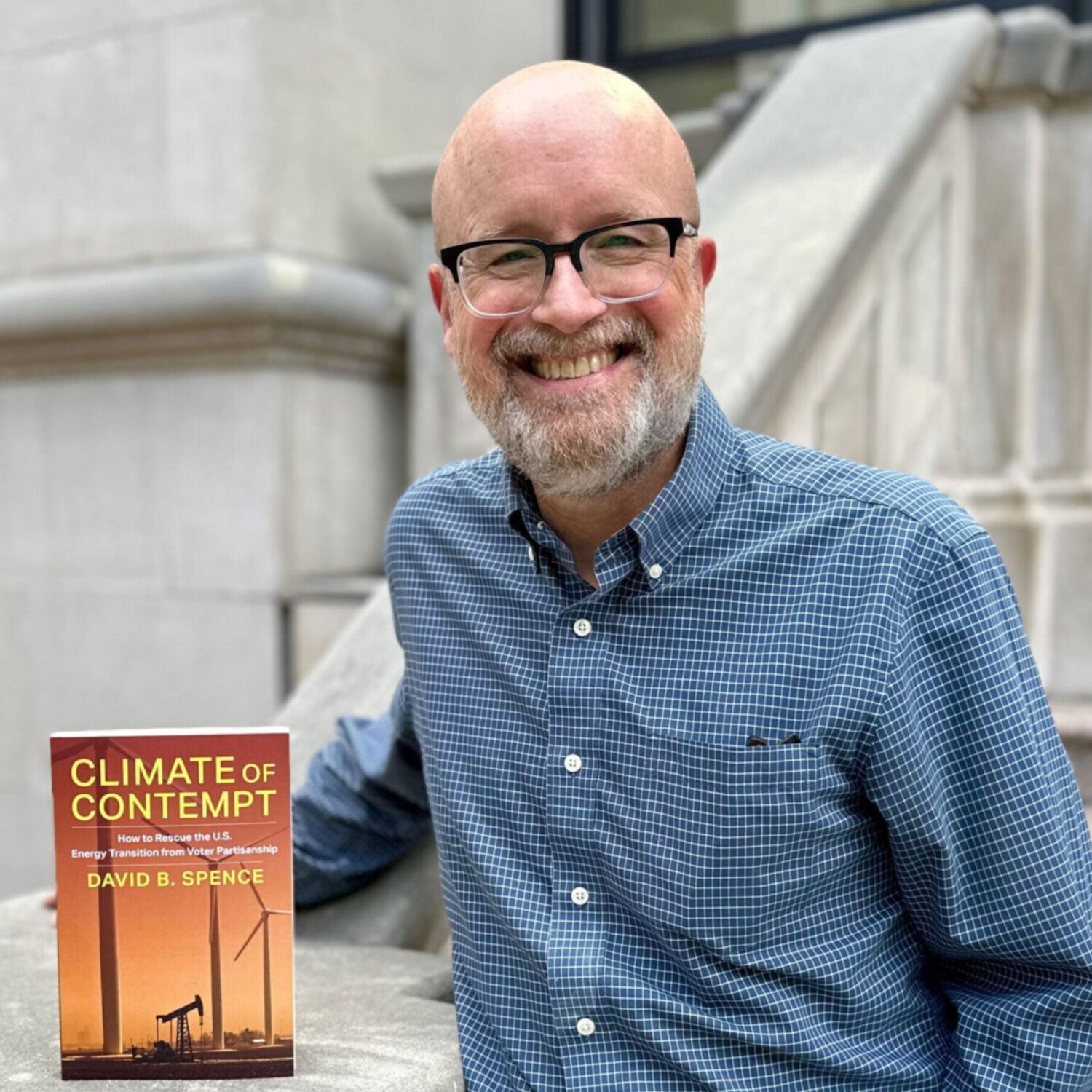
So much of environmental law these days concerns the energy industry, and there is no better place to study energy law.
Prof. David Spence
Opportunities extend beyond the classroom. Environmental Clinic students work with Texas communities on solutions to environmental challenges including pollution, access to safe drinking water, and climate change. Meanwhile, the Environmental Law Society offers several career panels a year, and there are law journals focused on both the environment and energy. Graduating students can earn a fellowship to work with a public interest environmental legal organization. And alumni have found successful careers at public interest and nonprofit organizations, federal and state environmental agencies, small and plaintiff-side firms, Big Law applying for permits and defending companies against enforcement cases, and traditional and renewable energy companies.
Lone Star Location
Where the school is situated matters. “At law schools, the location is more important than students realize in affecting what they learn about,” says Wagner, noting Texas has both many “precious environments and national parks” but also “petroleum spills and pollution in some of our cities. We probably have some of the highest environmental impacts and most precious environmental resources,” she says.
At law schools, the location is more important than students realize in affecting what they learn about.
Prof. Wendy Wagner
Additionally, Wagner notes that preemption—”if a governmental actor wants to do something and they are precluded by a higher authority, then that ends the conversation,” she says—”is at the centerpiece of what’s happening in environmental law.” Texas is the state with the most activity at all levels, she explains, between state and federal as well as localities and the state. The result? Opportunities “that are really ripe for research and student activism,” Wagner says.
Claudia Gutierrez ’23 came to law school from the Rio Grande Valley in South Texas with an open mind regarding her legal career, and after her 1L year, she enrolled in “any and all” courses that “piqued” her interest. Those included animal, environmental, and water law. Gutierrez says her Texas Law education provided grounding in environmental justice as well as connections for her summer jobs. The school’s internship program enabled her to intern for class credit with the office of the attorney general’s environmental protection division, where she now works as assistant attorney general. “After interning here, I knew this was the work I truly wanted to do,” Gutierrez says.
Other students enroll already wanting to pursue environmental law. “I chose Texas Law in large part for its environmental offerings, specifically as they related to environmental law in Texas,” says Chloe Fisher ’26, who initially left her hometown of Houston for undergraduate degrees at UT in sustainability studies and philosophy. “Texas Law’s connections to the Texas environmental law landscape through clinical, doctrinal course, and journal offerings made it a great fit for me,” Fisher says.
Texas Law’s connections to the Texas environmental law landscape through clinical, doctrinal course, and journal offerings made it a great fit for me.
Chloe Fisher ’26
Earth Day Inspiration
But Texas Law didn’t always have such robust environmental offerings and opportunities.

McGarity—now the William Powers, Jr. and Kim L. Heilbrun Chair in Tort Law—was a student at the Law School when it had no environmental course offerings, much less an experiential component. McGarity’s interest in the subject began during his undergraduate studies at Rice University in Houston, when the school celebrated the first Earth Day in 1970 —alongside other colleges nationwide—for an entire week. In recognition of the event, Rice offered a course on the environment. “We had a visiting author come in for Earth Week. His name was Frank Herbert,” McGarity says. (The “Dune” author lived in Rice’s student dorms for a week. “He was a very nice, modest guy with a bushy beard who loved to just bull****,” McGarity recalls.)
“I was inspired by that first Earth Day,” McGarity says, “when interest in the environment was starting to take off.”
When he returned to UT as a faculty member, McGarity started teaching environmental law courses in the 1980s. By the end of the decade, he was teaching up to 100 students in a five-hour survey course called Environmental Law, with interest spurred by the 1980 establishment of Superfund—“responsible for cleaning up some of the nation’s most contaminated land and responding to environmental emergencies, oil spills, and natural disasters,” according to the Environmental Protection Agency website. At the time, “there was a lot of interest because the law firms all wanted to get into the action,” McGarity says. “Companies were facing liability and needed advice.”
Building Expertise
The school’s expertise has since expanded. Wagner—a leading authority on the use of science by environmental policymakers—joined the faculty in 2001. Her “courses on the science of environmental law are legendary,” says colleague Spence. Wagner currently teaches on toxics as well as torts, which intersect with environmental law, and recently launched a seminar called Cities and the Environment. (She’s also writing a book with McGarity, tentatively titled “Agencies in Shackles,” which finds that government agencies have little ability to carry out their own mandates.)
Today, McGarity teaches courses on air, water, and climate law; a seminar on food safety; and on torts. He describes his scholarship as “pretty eclectic,” writing mostly on the Clean Air Act, pesticides, and toxics, as well as doing some work on water.
“Tom McGarity and Wendy Wagner are superstar legal academics nationally,” Spence says.
Before becoming professors, McGarity worked at the EPA, Wagner at the Department of Justice, doing environmental work, and Taylor for the advocacy nonprofit Environmental Defense Fund, notes Prof. Kelly Haragan ’95, director of the school’s Environmental Clinic. “They’re leaders in publishing and research on these issues but have practical experience in the field, too,” says Haragan.
Other faculty are environmental powerhouses, as well.
For three decades, Prof. Jeff Civins ’75 has taught an annual spring seminar on environmental litigation and previously led a seminar on environmental law concerns to business. Civins, senior counsel with Haynes and Boone LLP in Austin, has practiced all aspects of environmental law since 1975, when no environmental law courses were offered. “The Law School has come a long way,” Civins says.

Many graduates are leaders in the state and national bar and remain closely engaged as adjuncts, mentors, contributors, and continuing legal education presenters.
Prof. Jeff Civins ’75
“UT Law’s alumni community further strengthens its environmental program: many graduates are leaders in the state and national bar and remain closely engaged as adjuncts, mentors, contributors, and continuing legal education presenters,” he says. “The LL.M. program extends this reach internationally, with students from around the world enhancing the school’s global impact.”
Starting in 2002, Prof. Jane Cohen has brought her expertise to the Law School. Cohen teaches on water law and policy and is affiliated with an interdisciplinary group of scientists researching bioprecipitation, the biological nucleation of ice, rain, and snow. Prof. David Adelman joined the law faculty in 2009, and the Harry M. Reasoner Regents Chair in Law was awarded a grant that began in December 2024 on renewables research.
Outstanding on Energy
Meanwhile, the KBH Energy Center is a multidisciplinary endeavor of Texas Law, the McCombs School of Business, the Cockrell School of Engineering, and the Jackson School of Geosciences focused on the critical energy issues and challenges facing our planet.
At Texas Law, “we’re pretty unique in the extent to which we’re covering the energy transition into renewables,” McGarity says. On that topic, Spence won UT’s Hamilton Book Award for 2025 for his book, “Climate of Contempt: How to Rescue the U.S. Energy Transition from Voter Partisanship,” the university’s highest honor for outstanding scholarship in book form.
Prof. Rebecca Diffen ’09 was a wind developer before enrolling at Texas Law, and Smith’s wind law course was introduced during Diffen’s 2L year. “It’s a great example of energy and environment coming together, but also how lucky we were to have someone who was always looking at the new thing and thinking about it broadly,” she says of Smith. Diffen would later co-author with Smith “the first major overarching article about wind law” published in the Texas Journal of Oil, Gas, and Energy Law (their paper would form the basis of the book “Texas Wind Law”), and she now teaches Wind and Solar Law.
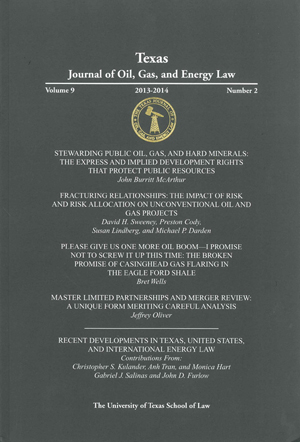
TJOGEL started flowing in 2005, when a group of students—Brandon Seale ’08, Nicholas Franklin ’07, Cynthia Martinez ’07, and Amy Maxwell ’07—launched it as the first student-run energy law journal. Today, TJOGEL hosts an annual energy law symposium and events throughout the year where practitioners meet students pursuing careers in energy law.
“In my first year of law school, I became interested in renewable energy and recognized it as an opportunity to become an expert in a new area of law,” says Martinez, who later worked as Smith’s research assistant on wind law.
She was “adamant about including the ‘and energy’ in the journal’s title” so it could cover energy content beyond oil and gas, Martinez says. “As a young lawyer, I published ‘Recent Updates in Solar Energy Law’ in the journal and spoke at its symposium, providing an overview of the nascent field of solar energy law,” she says. “These were all excellent professional development opportunities as a young lawyer.”
Maxwell, meanwhile, first came to UT from Kilgore, Texas to earn her undergraduate degree in government. With no attorneys in her family, Maxwell nevertheless did follow three generations of independent oil and gas operators. In law school, she focused on traditional oil and gas law, benefitting from networking opportunities through TJOGEL and student organizations. “You have so many things that together help prepare students for careers in oil and gas or renewables,” Maxwell says.
She later became a lobbyist working primarily with oil, gas, and pipeline company clients. “You have to understand renewables, because they’re part of the whole energy portfolio,” Maxwell says. “And when you’re lobbying, you need to be able to talk about energy efficiency and renewables. For oil companies, that’s also part of their world now.”
Clinic Opportunities
Texas Law’s Environmental Clinic provides students with practical experience “on a broad spectrum of environmental issues,” says Haragan, clinical professor and the clinic’s director. Clients typically include nonprofits, community organizations, or low-income individuals who live near major industrial facilities or cleanup sites. Recently, the clinic has been doing more work on issues of drinking water quality. The clinic often collaborates across UT, including with the Cockrell School for help monitoring clients’ air and water quality, as well as the Jackson School and LBJ School of Public Affairs.
What can law students expect to do in the clinic? Haragan says it depends on the case. “If a community comes to us and has concerns, let’s say about their air quality—their eyes burn and throats hurt, but they’re not sure what’s going on—students will look through agency files to find, ‘What are the air pollution sources in this area? What are the pollution limits? Are those limits being violated? If so, are those pollutants the kind of things that cause the symptoms people are experiencing?’”
Erin Gaines ’13 joined the clinic in 2024, bringing her expertise representing communities and nonprofit groups in cases addressing air and water pollution and climate change. “I love that I get to continue to work with former students like Erin,” Haragan says. “And we work on cases with former students who are now practicing law. That’s probably the most fun thing about my job.”

We work on cases with former students who are now practicing law. That’s probably the most fun thing about my job.
Prof. Kelly Haragan ’95
Adrian Shelley ’10, the Austin-based Texas director of national consumer rights advocacy organization Public Citizen, cites the clinic as a formative law school experience. “I can trace my professional path directly back to the clinic,” he says, specifically highlighting a guided visit to East Houston and the Houston Ship Channel.
“I was touring communities with homes literally in the shadow of a petrochemical storage tank,” Shelley says. “That was eye-opening to me.”
At the time, the clinic was led by Taylor. As a student, Shelley worked with then-associate director Haragan on his clinic project, and they continue to collaborate. “We have two projects underway right now with the Environmental Law Clinic,” he says. “My student-professor relationship with Kelly transformed into a professional one. She’s had a significant role in my school and professional development.”
Paul DiFiore ’25 also enrolled in the clinic, including as an advanced student—having previously taken the clinic and returning solely to do case work—where he was able to select his cases. “Kelly was very helpful and encouraging. It was fun to spend hours of my week on practical cases that I was personally passionate about because I had chosen them,” says DiFiore, now at an associate attorney with public interest environmental law firm Perales, Allmon & Ice PC in Austin. “The advanced clinic was a great time.”
Current students agree. “Participating in the environmental law clinic was the best choice I made in all of law school,” says Fisher.
Other Opportunities
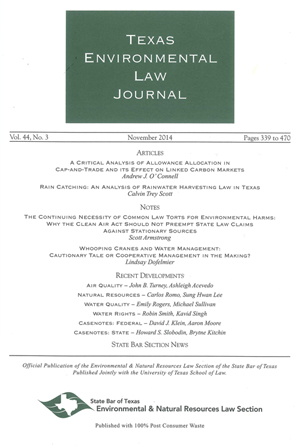
Fisher is also editor-in-chief of the Texas Environmental Law Journal’s volume 56. “Joining TELJ as a 1L allowed me to dive into the environmental legal world in the middle of my required first-year courses,” she says.
TELJ publishes two issues annually. For those students interested in environmental or administrative law more generally, Fisher says the journal offers an “incredibly valuable” experience. TELJ’s “articles and notes often explore the complicated administrative landscape surrounding environmental regulation,” she says. “More than that, TELJ is a great experience for anyone who wants to improve their legal writing or bluebooking skills.” After graduation, Fisher will work as a legal fellow at nonprofit public interest organization Earthjustice in its Gulf Regional Office in Houston, where she will be supervised by managing attorney Jen Powis ’03.
“You have TJOGEL and TELJ, two journals that focus on different aspects of this area,” says Diffen. “They’re great at giving students another piece of the well-rounded experience.”
There’s also financial support for Texas Law grads who pursue environmental work.In 2025, the school launched the two-year Environmental Justice Fellowship, awarded to a graduating student or judicial clerk working with a public interest environmental legal organization. Srivatsan Senthilkumar ’26 became the first recipient for his work supporting nonprofit Texas RioGrande Legal Aid’s Utility Accountability Project, which addresses rapidly rising electricity and water rates in Texas, driven by population growth, climate pressures, and expanding commercial demand.
Career Success
On the career front, Diffen—who also heads the Texas projects team in Norton Rose Fulbright LLP’s Austin office—has seen former students find success on the business side with renewable energy developers. Law school “is great for people who move into development work,” she says, “because you have that legal foundation.”
“I think it’s under-recognized how good of a program and what strong faculty we have,” DiFiore says of Texas Law’s environmental legal offerings. “You can take this track, have such a great experience, and it can easily lead to a career.”

The legal areas of environmental and energy are only going to get busier. There’s more coming in the future for our students.
Prof. Rebecca Diffen ’09
In fact, current developments point to increasing demand for environmental lawyers, with Diffen noting the challenges around artificial intelligence include how to power it. “We have to build so much new infrastructure, and there are the environmental aspects,” she says, pointing to data centers and the power sources necessary to drive them. “The legal areas of environmental and energy are only going to get busier. There’s more coming in the future for our students.”